
Gemini Omni 1.2 Flash Price: What a 15s Video Costs
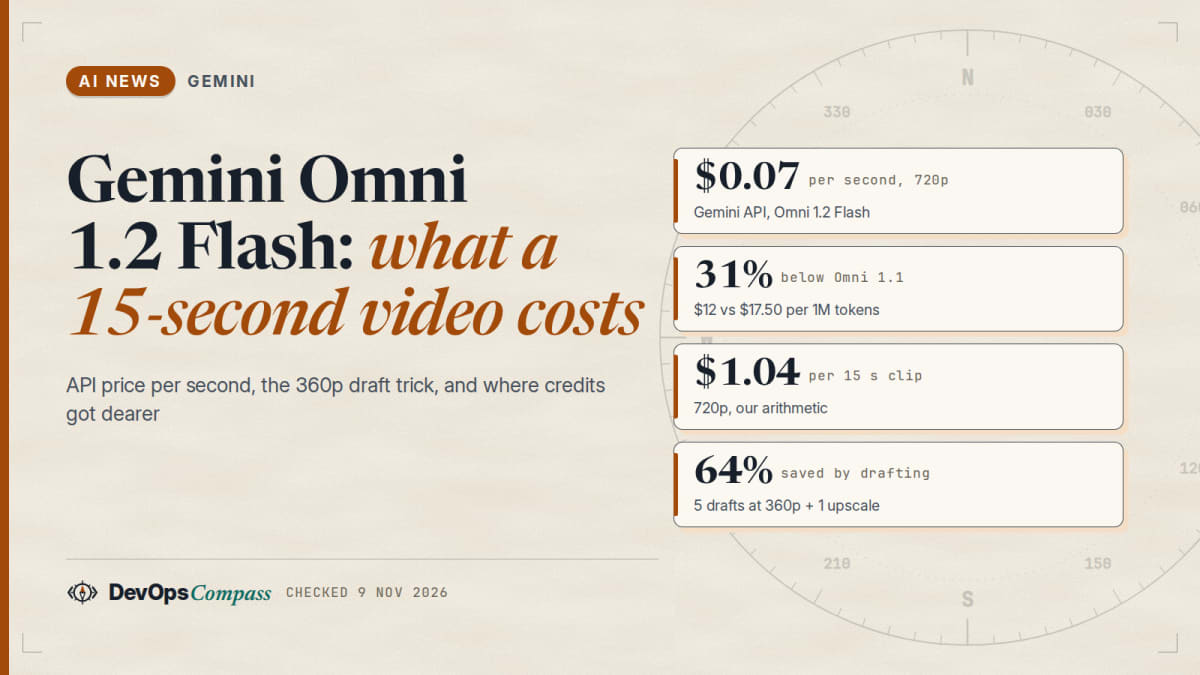
In short: Google released Gemini Omni 1.2 Flash (gemini-omni-1.2-flash) on 5 November 2026. It makes video with sound up to 15 seconds and costs about $0.07 per second at 720p through the Gemini API, which is 31% less than Omni 1.1 ($0.10 per second). A 15-second 720p clip is about $1.04. The bigger saving is not the price cut: the price list says a 360p draft costs a third of a 720p one ($0.023 per second), and upscaling is billed separately. On our arithmetic that makes five drafts plus one upscale about 64% cheaper than five 1080p generations. The catch: users report that Flow credits doubled for the same clip, and the free tier does not exist on the API. How this article was made: we read Google's launch posts, the Gemini API and Vertex AI price pages, the docs and the Hacker News thread, and did the sums ourselves. We did not generate a single video.
The questions this answers: what does a clip really cost, is it really 30% cheaper, is it free anywhere, is it better than Veo, and why can some people not find it? Official facts, user reports and our opinion are kept apart, and every dollar figure is calculated from Google's own price pages.
Official facts
Checked on 9 November 2026. Google's launch post is dated 5 November.
| Item | Fact | Source |
|---|---|---|
| Model ID | gemini-omni-1.2-flash, generally available on the Gemini API and Google Cloud |
Gemini API changelog |
| Clip length | 3 to 15 seconds in one-second steps; default 10 s (Omni 1.1: up to 10 s) | Omni docs |
| Output | Video with native audio; 360p, 720p (default), 1080p and 4K (the last two are "upscaled") | Omni docs |
| References | Up to 6 reference images; short reference video clips (up to 3 s) | Omni docs |
| Editing | Multi-turn editing; extension of 3 to 10 s per turn, up to 30 s in total, only at the end of a clip | Omni docs |
| Price (API) | Input $1.50 per 1M tokens; video output $12.00 per 1M tokens (Omni 1.1: $17.50) | Gemini API pricing |
| Free tier | Not available on the API | Gemini API pricing |
| Watermark | All output carries an invisible SynthID watermark | Omni docs |
How much does a Gemini Omni clip cost?
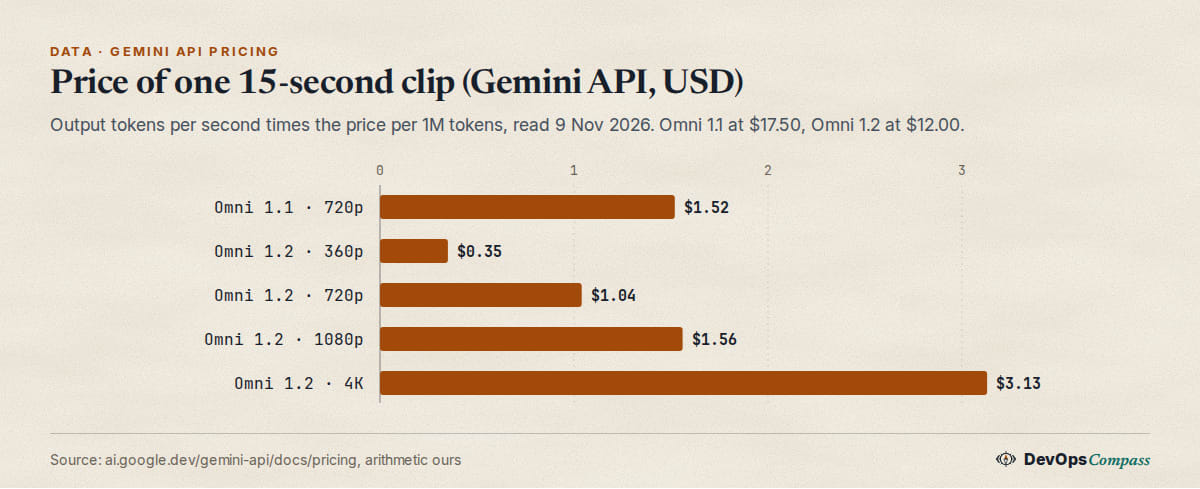
Google bills video by output tokens, then quotes an "effective price". The page says billing uses 5,792 tokens per second of 720p video and that $12.00 per million tokens equals about $0.07 per second. The other rates are on the same page: 1,931 tokens per second at 360p, 8,688 at 1080p and 17,376 at 4K. Multiplying out gives this table for the Gemini API, with the arithmetic ours:
| Output | Tokens per second | Price per second | 10 s clip | 15 s clip |
|---|---|---|---|---|
| Omni 1.1, 720p ($17.50 per 1M) | 5,792 | $0.1014 | $1.01 | $1.52 |
| Omni 1.2, 360p | 1,931 | $0.0232 | $0.23 | $0.35 |
| Omni 1.2, 720p | 5,792 | $0.0695 | $0.70 | $1.04 |
| Omni 1.2, 1080p | 8,688 | $0.1043 | $1.04 | $1.56 |
| Omni 1.2, 4K | 17,376 | $0.2085 | $2.09 | $3.13 |
Google's own page quotes about $0.70 for a 10 s clip and $1.04 for a 15 s clip at 720p, which matches. Inputs cost extra: images count 1,120 tokens each and input video up to 5,792 tokens per second, at $1.50 per million (Vertex AI page). A reference photo costs a fraction of a cent, so for a plain text-to-video call the output line is the bill.
Is it really 30% cheaper?
On the API, yes. $12.00 against $17.50 per million tokens is a 31.4% cut, from $0.1014 to $0.0695 per second of 720p video. Google says "30%", so its number is a slightly rounded version of the real one. The same page says that from 3 December 2026 all calls to gemini-omni-1.1-flash are routed to 1.2 and billed at the 1.2 rate, with no code change, so existing users get the cut automatically.
Outside the API the picture is less clear. Hacker News commenters who use Google Flow, Google's video tool with a credit system, report the opposite direction (see the user reports below). We could not check Flow's credit prices ourselves.
Is drafting at 360p and upscaling cheaper?
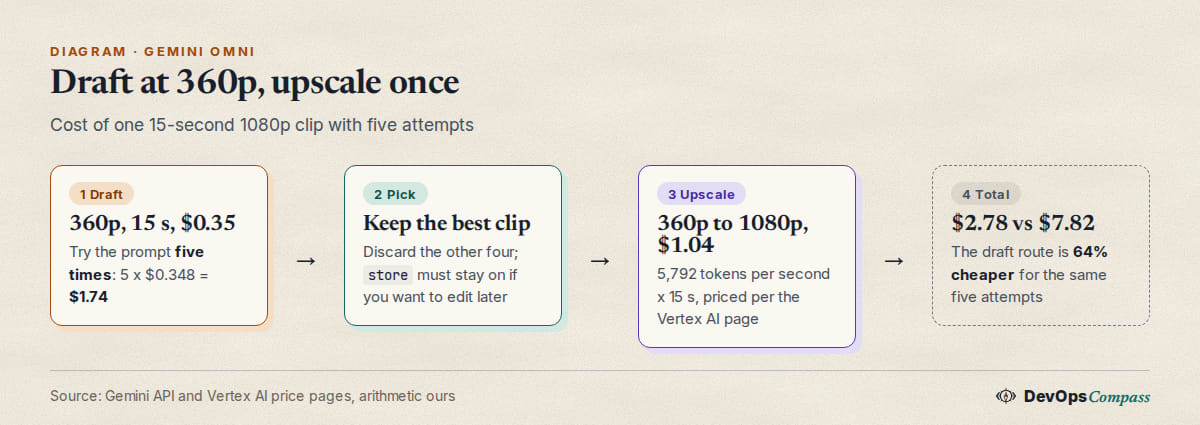
According to the price list, yes, by a wide margin. Google's launch post suggests the workflow itself: "draft fast at 360p or 720p, fix a detail with a follow-up edit instead of re-generating the entire clip, and then upscale your best creations to 1080p or 4K". The Vertex AI pricing page puts numbers on upscaling: 2,896 tokens per second from 360p to 720p or from 720p to 1080p, 5,792 from 360p to 1080p, and 11,584 from 720p or 1080p to 4K, with no extra input charge.
A worked example for one 15-second 1080p clip where you need five attempts to get one you like:
| Route | Calculation | Total |
|---|---|---|
| Generate at 1080p five times | 5 x 15 s x $0.1043 | $7.82 |
| Five 360p drafts, upscale the winner from 360p to 1080p | 5 x $0.348 + 15 s x $0.0695 | $2.78 |
That is 64% less for the same count of attempts. For an agency making 20 ad variants with five attempts each, it is about $156 against $56. Two assumptions hide in this: that the upscale step re-uses the draft you picked (the launch post says "upscale your best creations", so we read it that way), and that a 360p draft shows enough detail to judge the clip. The upscale rates come from the Vertex AI page; the Gemini API page quotes only the one-step 1080p and 4K prices. We did not run it, so treat it as a plan to check on your own first invoice.
What are the limits of the API?
Rate limits matter for cost planning because they cap spend as well as speed. The rate-limits page lists, for gemini-omni-1.2-flash: Free tier not supported; Tier 1: 8 requests per minute and 40 per day; Tier 2: 16 and 200; Tier 3: 40 and 2,000. At 15 s and 720p, a Tier 1 account can spend at most about $42 a day (40 x $1.04) before it hits the daily cap. The changelog says paid-tier limits doubled compared with Omni 1.1.
Other limits from the docs: extending a video only appends to the end; first-and-last-frame clips are capped at 10 s; uploaded-video editing and extension are unavailable in the EEA, Switzerland and the UK; negative prompts, temperature and system instructions are not supported; English is the only language Google fully evaluated.
Is Gemini Omni free?
Not on the API: the free tier is listed as not available. Elsewhere, Google offers limited free use. The Google Vids announcement says anyone with a Google account or a Workspace subscription can make up to three 15-second videos a month in Vids at no cost. The Gemini app gets 15-second videos on the Google AI Ultra plan first, according to the launch post, and Flow and Google Ads are also listed. Whether the Gemini Pro or free plans get it, and when, is not stated, which is why searches such as "is Gemini Omni included in Gemini Pro" have no clean answer yet.
Gemini Omni or Veo 3.1: which is cheaper?
We cannot give an honest per-second answer yet. The Vertex AI page lists Veo 3.1 and its Fast and Lite versions at prices such as $0.40, $0.10 and $0.05 "per count", but the page text we read does not say what a "count" is, and the same page uses "count" for a whole song and a 30-second music clip. Omni is priced per token of output, Veo per count. Until Google states the unit, any table that puts them side by side is a guess. What we can say: Omni 1.2 Flash is priced as a mid-range "Flash" video model with editing, references and extension; Veo is Google's older video family with its own price tiers. Read the Veo unit on your own invoice before comparing.
Why is Omni not showing up for me?
Because the rollout is staggered, by Google's own post: the API and Gemini for business first, Vids and Flow next, the Gemini app on Ultra only, and the API needs a paid tier. Users who paid for consumer plans report being unable to find it (see below). If you want certainty, call the API: with billing enabled, client.interactions.create(model="gemini-omni-1.2-flash", input="...") is the call in Google's docs, and the video comes back as base64 in interaction.output_video.data. We did not run it.
What users report
Hacker News had 367 points and 38+ comments when we read the launch thread on 9 November. These are individual claims, none verified by us. Reddit blocks our tools.
- Flow got pricier. cube00 wrote that a 720p 10-second clip cost 15 credits in Omni 1.1 and costs 30 in 1.2, and that Google's launch post does not mention it. kakugawa summarised it as "double the cost in Flow, but 30% cheaper via the API", adding that Flow has long been cheaper than the API. predkambrij saw 30 credits per prompt and a 50-credit daily refresh, so about one free clip a day.
- Quality is incremental. msabalau, who makes clips in Flow, found no clear quality jump yet and said they would reach for it "when character consistency is punching me in the face". fuzzythrowaway2 wrote that the 15 s mode cannot use first and last frames, and that unusual character designs drift towards "tv commercial blandness".
- Confusing access and names. Willingham described contradictory answers about which plan gets it when; ilioscio and others said they pay and still cannot test it. Several commenters were puzzled that a video-only model is called "Omni".
- Reliability. yipinwong saw 68% uptime for Gemini on OpenRouter while testing.
- Is there a market? hypfer asked whether 15 seconds is only B-roll, and thisisauserid answered that advertising is Google's main revenue and this feeds it.
Our take
Thesis: the 30% price cut is real but small. The thing that changes your bill is a workflow Google sells almost in passing: draft cheap, upscale once. If you pay per second through the API or Vertex AI, you do not need to do anything for the cut, because 1.1 traffic is rebilled at 1.2 rates on 3 December. But a 31% discount on a clip you regenerate five times is still five clips. Reading the price list, one 360p draft costs a third of a 720p one, and an upscale from 360p to 1080p costs as much as one 720p generation. For anyone making many variants (ads, product shots, social clips), the sums above say the route saves more than the whole announcement did, and it costs nothing to try.
Three things I would do before committing a budget:
- Budget per kept clip, not per second. Count your average number of attempts. At five attempts a 15 s 1080p clip really costs about $7.80 directly or $2.80 with drafts, not the $1.56 on the price page.
- Check the invoice, not the blog. Google's blog says Provisioned Throughput is available; the API docs say it is "not supported". Flow's credits seem to have gone the other way. The two Google pages and the HN reports disagree, so run ten test clips and compare the billed amount with the tables above before scaling.
- Stay on the API for cost control; use Flow or Vids for creative work. The API has a clear per-second price and rate limits that cap a surprise bill (Tier 1 at roughly $42 a day). Credit systems hide the price, and users say it moved against them.
Who should skip it: anyone who needs a clip longer than 15 seconds without extension steps, first-and-last-frame control at the full length, or non-English prompts at known quality. Who should wait: consumer subscribers who cannot see the model yet. If you also watch other AI bills, our guides to GPT-6.1 Terra API pricing and the Claude Haiku 5.5 API price list use the same method: turn the token price into a cost per task.
What we did not test
- We did not generate any video, call the API, or open Flow, Vids or the Gemini app. All prices are Google's, all totals are our arithmetic.
- We did not verify that the upscale step re-uses a draft, that the Gemini API bills upscaling at the Vertex AI rates, or what a multi-turn edit costs. The price pages do not say.
- We did not check Veo's unit ("count") or Flow's credit tables. Every Flow figure comes from Hacker News comments.
- We judged no output quality. Claims of better consistency are Google's and the commenters'.
FAQ
How much does Gemini Omni 1.2 Flash cost?
About $0.07 per second of 720p video through the Gemini API, which is about $1.04 for a 15-second clip. 360p is $0.023 per second, 1080p $0.104 and 4K $0.209. Source: Google's Gemini API pricing page, 9 November 2026.
Is Gemini Omni free to use?
Not on the API, which has no free tier for this model. Google Vids gives anyone with a Google account up to three free 15-second videos a month, and the Gemini app starts with Ultra subscribers. Check which one you have before building a plan on it.
Is Gemini Omni 1.2 Flash cheaper than 1.1?
On the API, yes: $12.00 against $17.50 per million output tokens, or $0.0695 against $0.1014 per second at 720p, about 31% less. Users report that Flow now charges twice as many credits for the same clip, which we could not check.
What happens to gemini-omni-1.1-flash on 3 December?
From 3 December 2026 all requests to gemini-omni-1.1-flash are routed to gemini-omni-1.2-flash and billed at the 1.2 rates, with no code change. Until then 1.1 stays available.
What are the Gemini Omni API rate limits?
For gemini-omni-1.2-flash: Tier 1 allows 8 requests per minute and 40 a day, Tier 2 16 and 200, Tier 3 40 and 2,000. The free tier is not supported. The paid-tier limits doubled compared with Omni 1.1, per the changelog.
How long can a Gemini Omni video be?
3 to 15 seconds per generation, default 10. Extensions add 3 to 10 seconds per turn at the end of a clip, up to 30 seconds in total. First-and-last-frame clips are limited to 10 seconds.
Does Gemini Omni add a watermark?
Yes: every video carries an invisible SynthID watermark that can be detected programmatically. There is no visible logo mentioned in Google's docs.
Related guides
- GPT-6.1 Terra: API price, context, benchmarks and limits for the same token-to-task cost method on a text model.
- Claude Haiku 5.5 API: price and effort levels for another price-per-task breakdown.
- Gemini Keep Activity: does Google train on your chats? for what the consumer Gemini plans do with your data.
- ChatGPT and Codex shared limits for how a credit system can change the cost of the same work.
Sources
- Google: Gemini Omni 1.2 Flash launch post (5 Nov 2026) and Omni 1.2 Flash in Google Vids.
- Gemini API docs: pricing, Omni guide, rate limits, changelog.
- Google Cloud: Vertex AI generative AI pricing.
- Hacker News: thread 50392118.
- Google autocomplete suggestions for "gemini omni" and "gemini omni api cost" (9 Nov 2026).
Update log
- 9 November 2026: first version, from Google's launch posts, the Gemini API and Vertex AI price pages, the Omni docs and the Hacker News thread. We will update it when Google clarifies the upscale billing, the Veo "count" unit or the Flow credit table, and after the 3 December routing change.
Last verified: November 2026 (9 November 2026). Prices and rollouts change; we will update this page and the log above.
Header image: Image: DevOpsCompass.
Comments
Post a Comment