
GPT-6.1 Terra: API Price, Context, Benchmarks and Limits
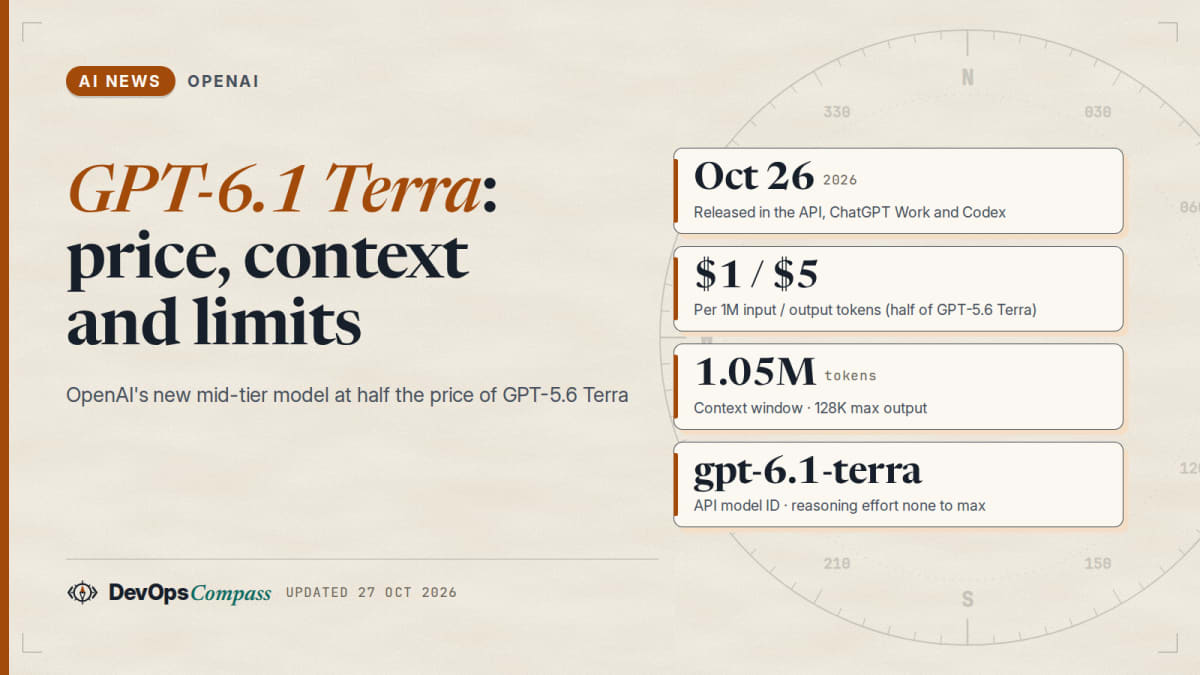
In short: the new Terra model (GPT-6.1) is OpenAI's new mid-tier model, released on 26 October 2026. It replaces GPT-5.6 Terra and sits between GPT-6 Luna (cheapest) and GPT-6.1 Sol. In the API it is called gpt-6.1-terra and costs $1 per million input tokens and $5 per million output tokens, about half of GPT-5.6 Terra ($2 / $12). It has a 1.05 million token context window, up to 128,000 output tokens, text and image input, and reasoning effort from none to max. In ChatGPT it is available to Plus, Pro, Enterprise and Edu users in ChatGPT Work and Codex (per launch coverage). How this article was made: a news roundup from OpenAI's API docs, pricing page and changelog, launch coverage and early user reports. We have not run the model ourselves.
OpenAI now sells four GPT-6 model classes: Luna, Terra, Sol and Astra, from cheapest to most capable. When GPT-6 Sol and Luna arrived last month, Terra was left out, so many API users stayed on GPT-5.6 Terra. The new Terra closes that gap. This article keeps three things apart: official facts (OpenAI's own pages), what users report in the first day (linked, not verified by us) and our take.
Official facts
Everything in this section comes from OpenAI's model page, pricing page, GPT-6 guide and API changelog, all checked on 27 October 2026. OpenAI's announcement page blocked our fetch tools, so benchmark numbers from it are quoted through named outlets and marked as such.
Key facts at a glance
| Value | |
|---|---|
| Released | 26 October 2026 (API changelog) |
| API model ID | gpt-6.1-terra (only snapshot so far) |
| Context window | 1,050,000 tokens (max input 922,000) |
| Max output | 128,000 tokens |
| Knowledge cutoff | 1 June 2026 |
| Input / output | text and image in, text out (no audio, no video) |
| Reasoning effort | none, low, medium (default), high, xhigh, max |
| API price | $1 input, $0.05 cached input, $5 output per 1M tokens |
| Endpoints | Responses, Chat Completions, Batch |
| Replaces | GPT-5.6 Terra |
OpenAI describes it as "a fast, efficient model for visual reasoning, precise computer use, and clear, natural writing". Its own examples: matching product photos to catalog entries, reading technical drawings, acting on application screens, and drafting or revising text.
Pricing, with the small print
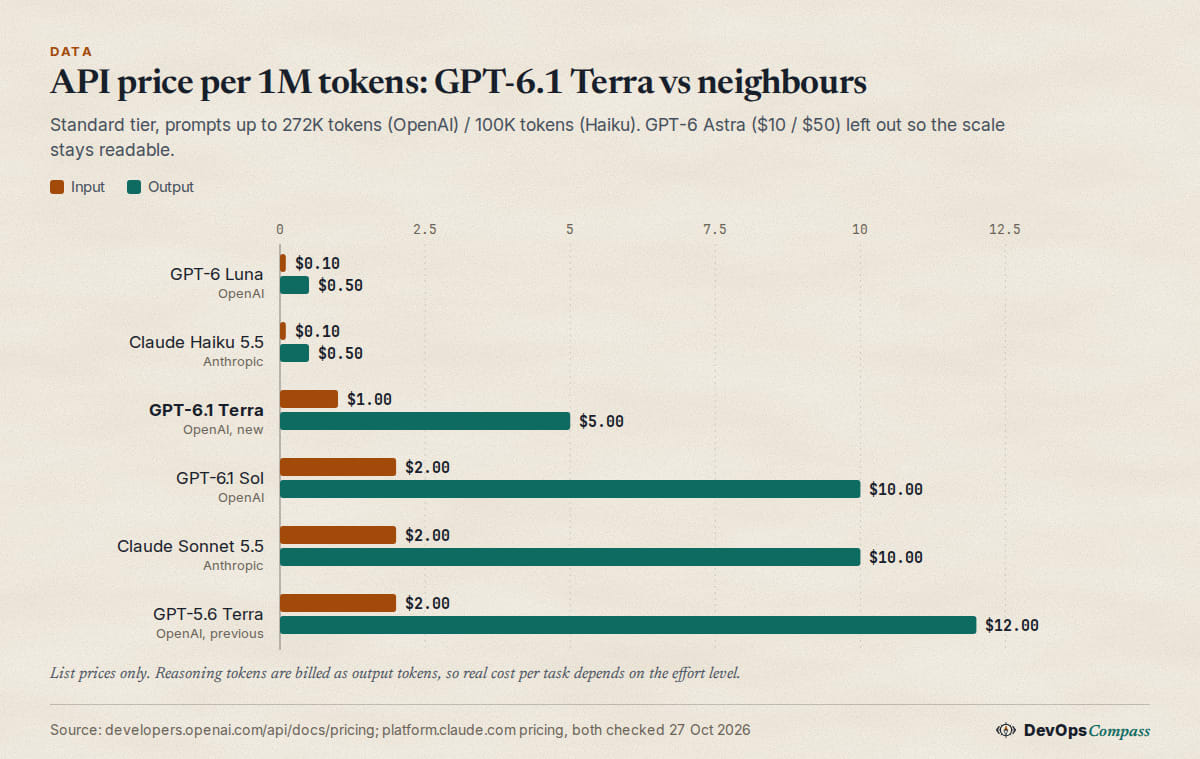
The pricing page lists these prices per million tokens for the GPT-6 lineup (standard tier, prompts up to 272K input tokens):
| Model | Input | Cached input | Output |
|---|---|---|---|
| GPT-6 Luna | $0.10 | $0.01 | $0.50 |
| GPT-6.1 Terra | $1.00 | $0.05 | $5.00 |
| GPT-6.1 Sol | $2.00 | $0.10 | $10.00 |
| GPT-6 Astra | $10.00 | $1.00 | $50.00 |
| GPT-5.6 Terra (previous) | $2.00 | $0.20 | $12.00 |
The details that change your bill, all from the model page:
- Long prompts cost more. If a request has more than 272K input tokens, the whole request is billed at 2x the input and cache rates and 1.5x the output rate.
- Cache writes are billed. Writing to the prompt cache costs $1.25 per million tokens for 30-minute retention and $2.50 for the new 12-hour retention. Cached reads then cost 5% of the normal input price.
- Batch and Flex are 50% cheaper ($0.50 / $2.50). Fast mode costs 2x ($2 / $10). Regional processing (data residency) adds 10%.
- Reasoning tokens are billed as output tokens (OpenAI reasoning guide). A higher effort level can cost much more than the per-token price suggests.
Worked example (our calculation from the price list): 10,000 requests, each with 3,000 input tokens and 500 output tokens (including reasoning), no caching, standard tier.
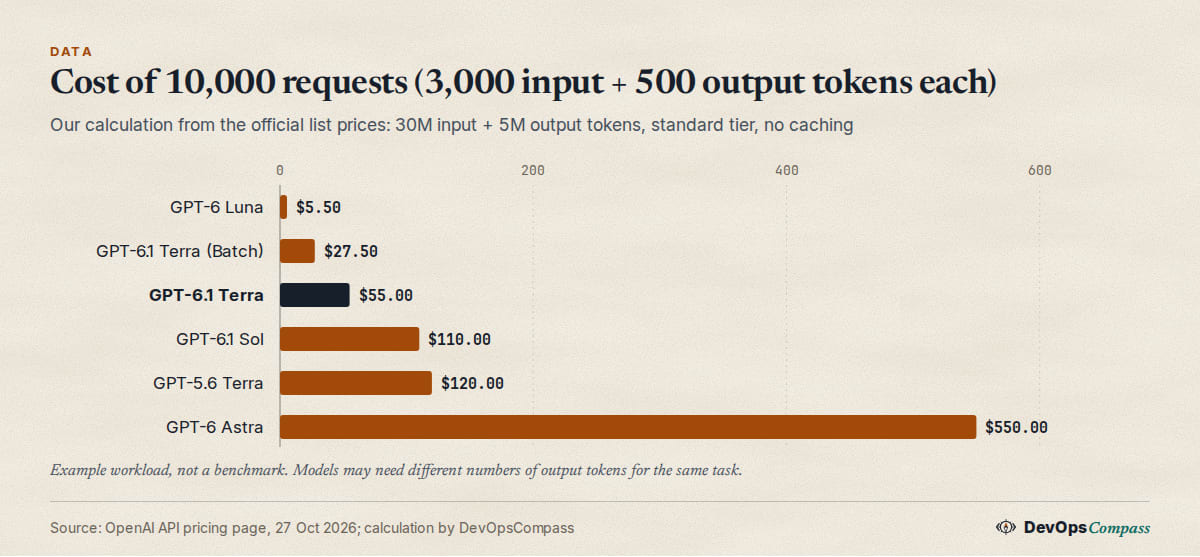
Terra comes to $55 (30M input tokens x $1 + 5M output tokens x $5). The same job costs $120 on GPT-5.6 Terra, $110 on GPT-6.1 Sol, $5.50 on GPT-6 Luna and $550 on GPT-6 Astra. Through the Batch API, Terra drops to $27.50.
Endpoints, tools and rate limits
- Supported: Responses API, Chat Completions, Batch. Not supported: Realtime, Live, Assistants, fine-tuning, embeddings.
- Tool calling requires the Responses API. Chat Completions works for plain prompts only.
- Tools in the Responses API: web search, file search, image generation, code interpreter, hosted shell, apply_patch, skills, computer use, MCP and tool search.
- Rate limits (standard): Build tier 5,000 requests and 1M tokens per minute; Launch tier 10,000 and 4M; Grow tier 15,000 and 40M.
- Unlike GPT-6 Astra and GPT-6.1 Sol, Terra supports
reasoning.effort: "none". Fast mode for Terra supports EU data residency (GPT-6 guide).
How to call it (from the official docs, not run by us)
The request shape follows the examples in OpenAI's reasoning guide, with Terra's model ID:
curl https://api.openai.com/v1/responses \
  -H "Content-Type: application/json" \
  -H "Authorization: Bearer $OPENAI_API_KEY" \
  -d '{
    "model": "gpt-6.1-terra",
    "reasoning": {"effort": "medium"},
    "input": "Summarise this incident report in five bullet points: ..."
  }'
If you migrate from GPT-5.6 Terra, OpenAI's guide says to compare both models on your own images and workflows at the same reasoning effort, and to move tool-calling requests from Chat Completions to the Responses API. When effort is not none, remove temperature, top_p and top_logprobs from your requests.
OpenAI's benchmark claims (as reported)
OpenAI's announcement includes its own test results. We could not open the page directly, so these numbers are quoted as reported by BleepingComputer and 9to5Mac on 26 October:
- Terminal-Bench 4.0 (coding, max effort): 50.3%, up from 21.5% for GPT-5.6 Terra.
- Factual errors on OpenAI's internal set of hard prompts: 16.7% at low effort (GPT-5.6 Terra: 53.6%) and 4.3% at max effort, which OpenAI says nearly matches GPT-6 Astra and GPT-6.1 Sol.
- Speed: OpenAI says Terra finishes tasks more than three times faster than GPT-6 Astra and GPT-6.1 Sol.
- Agents' Last Exam (medium effort): 15 percentage points above GPT-5.6 Terra at about a third of the cost.
- OpenAI still recommends Sol or Astra for the most complex coding work (per BleepingComputer).
Independent numbers. Artificial Analysis published its own results the same day: Terra scores 48 on its Coding Agent Index v2.0, against 54 for GPT-6.1 Sol and 31 for GPT-6 Luna. Its cost per task at max effort was $0.40, against $1.40 for GPT-5.6 Terra. On its AA-Omniscience test, the hallucination rate fell from 88% to 38%. Artificial Analysis also notes that only the low and medium effort levels sit on its cost-efficiency frontier.
How it compares
Versus GPT-6.1 Sol. Sol costs twice as much ($2 / $10) and scores higher on Artificial Analysis's coding index (54 vs 48). OpenAI positions Sol for complex coding and professional work and Terra for fast visual, computer-use and writing tasks.
Versus GPT-6 Luna. Luna is ten times cheaper ($0.10 / $0.50) and is OpenAI's choice for "focused, high-volume tasks". Terra is the step up when Luna's answers are not good enough.
Versus Anthropic. On price, Claude Sonnet 5.5 costs $2 / $10 per million tokens and Claude Haiku 5.5 $0.10 / $0.50 for prompts up to 100,000 tokens (Anthropic pricing page, checked 27 October). Terra sits between them. We found no benchmark that tests Terra and the Claude models in the same way from one source, so we make no quality comparison here.
What users report
The model is one day old. The reports below are early impressions from developers, linked so you can read them in context. We have not verified them.
- Big interest. OpenAI's launch post reached about 570 points and more than 350 comments on Hacker News within a day (Hacker News thread).
- Reasoning levels behave unexpectedly. Simon Willison found that at
noneandloweffort Terra spent no reasoning tokens in his test, and thatlowended up cheaper thannone(simonw, comment). - Max effort may not pay off. One tester reports that at max effort Terra did worse than GPT-6.1 Sol and cost about twice as much, while medium effort was the sweet spot (XCSme, comment). Another points to Artificial Analysis charts where Sol at xhigh is both cheaper and smarter than Terra at max (ralusek, comment).
- Fast and short answers. Plotly's data-analytics benchmark places Terra on the cost-performance frontier between Luna and Sol, says only two of 33 tested models finished faster, and notes it wrote the least output (chriddyp, comment). A hobby game benchmark reports 84 points for $0.19, ahead of Grok 4.7 at a fraction of the time and cost (thefourthchime, comment).
- Gives up early. One user says Terra, like Luna, "will stop at an earliest excuse" even when prompted to finish the job (agluszak, comment). Another says it burned through their Codex usage quickly by loading skills and memory files it did not need (wellthatsinsa, comment).
- "Why does the middle tier exist?" Several commenters find the four-tier naming confusing and question whether a mid-tier model beats "one tier up at lower effort" (Someone1234, comment; Silagi, comment; minimaxir, comment).
- Practical fits. A developer plans to use it for automated pull-request reviews, where top models are too slow and expensive on every diff (mehdizare, comment). Another, whose company agent runs on GPT-5.6 Terra, calls the drop in factual errors the most important change (bob1029, comment).
Press framing. BleepingComputer leads with "3x faster AI agents, 50% lower pricing" (BleepingComputer). 9to5Mac stresses that Terra was missing from last month's GPT-6 update and now replaces GPT-5.6 Terra (9to5Mac).
Our take
This is our opinion, based on the facts and reports above:
- If you run GPT-5.6 Terra in production, test 6.1 Terra now. The price drop is real and documented: input halves and output falls from $12 to $5. Compare both models at the same effort level, as OpenAI advises, and watch the output-token count, not just the price per token.
- Start at
lowormediumeffort. Both Artificial Analysis and early testers suggest the higher levels lose the cost advantage. If you needxhighormax, try GPT-6.1 Sol first. - Use it for volume work with images or screens: document and form processing, catalog matching, PR summaries, support drafts. Use Luna when the task is simple and Sol or Astra when mistakes are expensive.
- Keep prompts under 272K tokens unless you really need more. Above that, the whole request costs 2x on input.
- Budget for agents carefully. Computer use and tool calls multiply tokens. Cap
max_output_tokens, log costs per task, and give agents only the access they need, the same rule we apply in our Terraform MCP server setup and safety guide. - Prefer local models for private, simple tasks? A small model on your own server can still make sense; see our guide to running Ollama without a GPU in Docker.
What we did not test
- No hands-on use and no API calls. The
curlexample above is copied from the documented request shape; we did not run it. - No benchmarks of our own. OpenAI's numbers are quoted through BleepingComputer and 9to5Mac, independent numbers from Artificial Analysis, and user results from the linked comments.
- ChatGPT availability (which plans, model picker names) comes from launch coverage; OpenAI's help center was not reachable for us.
- No quality comparison with Claude, Gemini or Grok models, because we found no single source that tests them in the same way.
FAQ
What is GPT-6.1 Terra?
It is OpenAI's mid-tier model in the GPT-6 family, released on 26 October 2026. It replaces GPT-5.6 Terra and sits between the cheaper GPT-6 Luna and the stronger GPT-6.1 Sol. OpenAI aims it at visual reasoning, computer use on application screens, and writing, with a 1.05 million token context window.
How much does GPT-6.1 Terra cost?
In the API it costs $1 per million input tokens, $0.05 per million cached input tokens and $5 per million output tokens. Batch and Flex are 50% cheaper, Fast mode is twice the price, and requests above 272K input tokens are billed at 2x input and 1.5x output for the whole request.
Is GPT-6.1 Terra better than GPT-6.1 Sol?
No. Sol is the stronger model and costs twice as much. On Artificial Analysis's Coding Agent Index v2.0, Sol scores 54 and Terra 48. Terra's advantages are price and speed: OpenAI says it finishes tasks more than three times faster than Sol and Astra.
GPT-6.1 Terra vs GPT-6 Astra: which should I use?
Use Astra, OpenAI's flagship at $10 / $50 per million tokens, for the hardest multi-step work. OpenAI claims Terra performs close to Astra on some tasks at a tenth of the token price, but it still recommends Sol or Astra for the most complex coding.
What is the difference between Luna, Terra, Sol and Astra?
They are OpenAI's four model classes, from cheapest to most capable: Luna for simple high-volume tasks, Terra for fast everyday and visual work, Sol for complex coding and professional work at a balanced price, and Astra as the flagship. Current versions are GPT-6 Luna, GPT-6.1 Terra, GPT-6.1 Sol and GPT-6 Astra.
Is GPT-6.1 Terra good?
Early reports are mixed but mostly positive on price and speed. Testers praise short, fast answers and a big drop in factual errors versus GPT-5.6 Terra. Others say it gives up early on long tasks and that max effort is not worth the cost. Test it on your own workload at low or medium effort.
How does GPT-6.1 Terra compare with Claude Sonnet 5.5?
On list price, Terra ($1 / $5 per million tokens) is half the price of Claude Sonnet 5.5 ($2 / $10). We found no independent benchmark that compares the two models in the same way yet, so we cannot say which one gives better answers for your work.
What is the GPT-6.1 Terra context window?
The context window is 1,050,000 tokens, with up to 922,000 input tokens and up to 128,000 output tokens. Its knowledge cutoff is 1 June 2026. Remember that prompts above 272K input tokens are billed at a higher rate.
Sources
- OpenAI API docs: GPT-6.1 Terra model page (model ID, context, modalities, prices, endpoints, tools, rate limits; checked 27 Oct 2026).
- OpenAI API docs: Pricing (GPT-6 lineup and GPT-5.6 Terra prices, batch, fast mode).
- OpenAI API docs: Using GPT-6 guide (positioning, migration advice, limitations).
- OpenAI API docs: Changelog (26 Oct 2026 release entry) and Reasoning guide (reasoning tokens billed as output, request examples).
- OpenAI: Introducing GPT-6.1 Terra (26 Oct 2026; announcement, not readable by our tools).
- BleepingComputer: OpenAI launches GPT-6.1 Terra with 3x faster AI agents, 50% lower pricing (26 Oct 2026).
- 9to5Mac: OpenAI upgrades ChatGPT and Codex with new GPT-6.1 Terra model (26 Oct 2026).
- Artificial Analysis: GPT-6.1 Terra pushes the cost efficiency frontier (26 Oct 2026).
- Anthropic: Claude API pricing (Sonnet 5.5 and Haiku 5.5 prices, checked 27 Oct 2026).
- User reports: Hacker News launch thread and the comments linked above.
Update log
- 27 October 2026: first version (OpenAI docs and pricing, launch coverage of 26 October, Artificial Analysis results, first-day user reports).
Last verified: October 2026 (27 October 2026). Prices, rate limits and ChatGPT availability can change; we will update this page and the log above when OpenAI changes them.
Header image: Image: DevOpsCompass.
Comments
Post a Comment