
Mistral Large 4 Open Weights: Licence, Price, Hardware
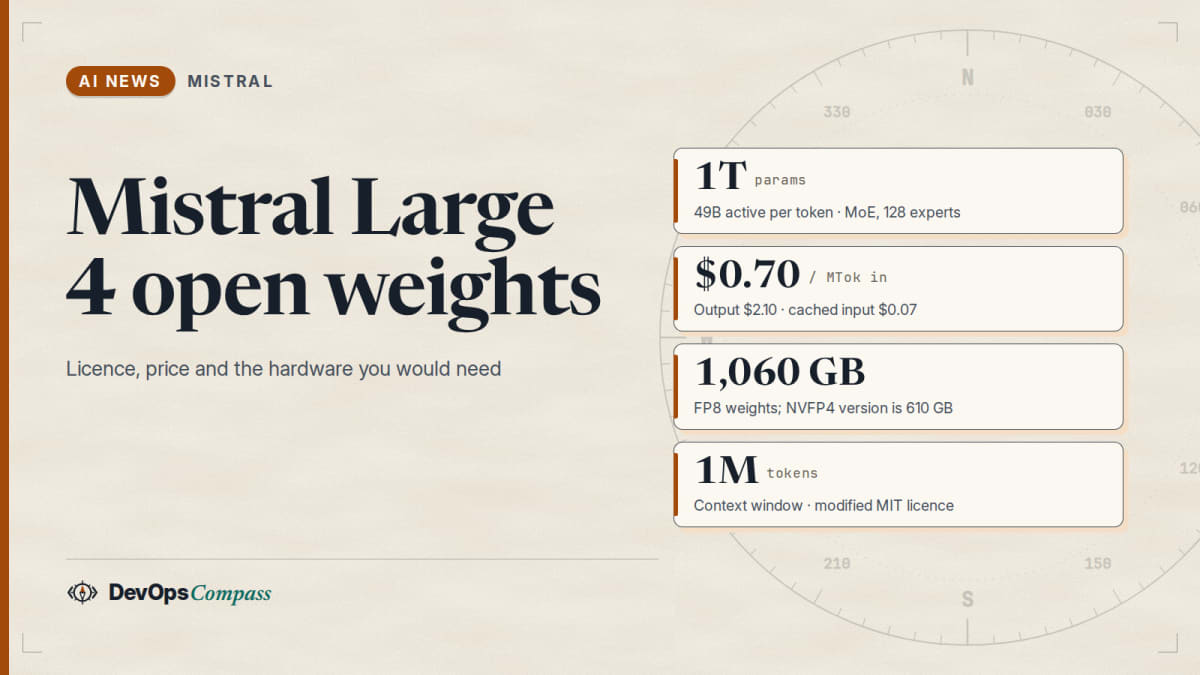
In short: On 29 October 2026 Mistral released the weights of Mistral Large 4 ("Le Chonk"), a 1-trillion-parameter mixture-of-experts model with 49 billion active parameters, a 1M-token context window and text-plus-image input. The licence is a modified MIT licence: free to use, modify and fine-tune, but a company that runs a Model-as-a-Service business needs a separate commercial licence. The Mistral API costs $0.70 input / $2.10 output per million tokens. Self-hosting is a data-centre job: the original FP8 files are about 1,061 GB, Mistral's NVFP4 version about 610 GB. How this article was made: we read Mistral's announcement, the Hugging Face model card and licence, the pricing page and the Hacker News thread. We did not run the model.
Mistral first put Large 4 on its API as a public preview in early October. This week it published the improved weights and cut the price. The questions that followed are practical: is it really "open"? can my company use it? what hardware does it need? We keep official facts, what users report and our take apart.
Official facts
Checked on 30 October 2026 against Mistral's announcement, its Hugging Face model card and its documentation.
| Mistral Large 4 | |
|---|---|
| Weights released | 29 October 2026 (API public preview since 6 October 2026) |
| Hugging Face repo | mistralai/Mistral-Large-4-1T-A52B |
| API model ID | mistral-large-4-0 in the docs; the model card says it is served as mistral-large-4 |
| Architecture | Mixture-of-experts: about 1T parameters, 49B active per token (52B with embeddings), 128 routed experts with 4 active, plus 1 shared expert |
| Input / output | text and images in, text out; 1.6B-parameter vision encoder |
| Context window | 1M tokens |
| Languages | "160+", including all official EU languages |
| Reasoning | low, medium, high (default high) |
| Recommended sampling | temperature=1.0, top_p=0.95 |
| Licence | Mistral Ecosystem Open-Weight License (modified MIT) |
Mistral also ships a quantized NVFP4 checkpoint (aimed at Blackwell GPUs, supported in vLLM and SGLang) and an embedded DSpark speculative-decoding head, which Mistral says gave up to 1.9x throughput in its own measurements. The company says a full technical report is "coming soon", and that a cybersecurity variant is in preview for vetted partners only.
Pricing
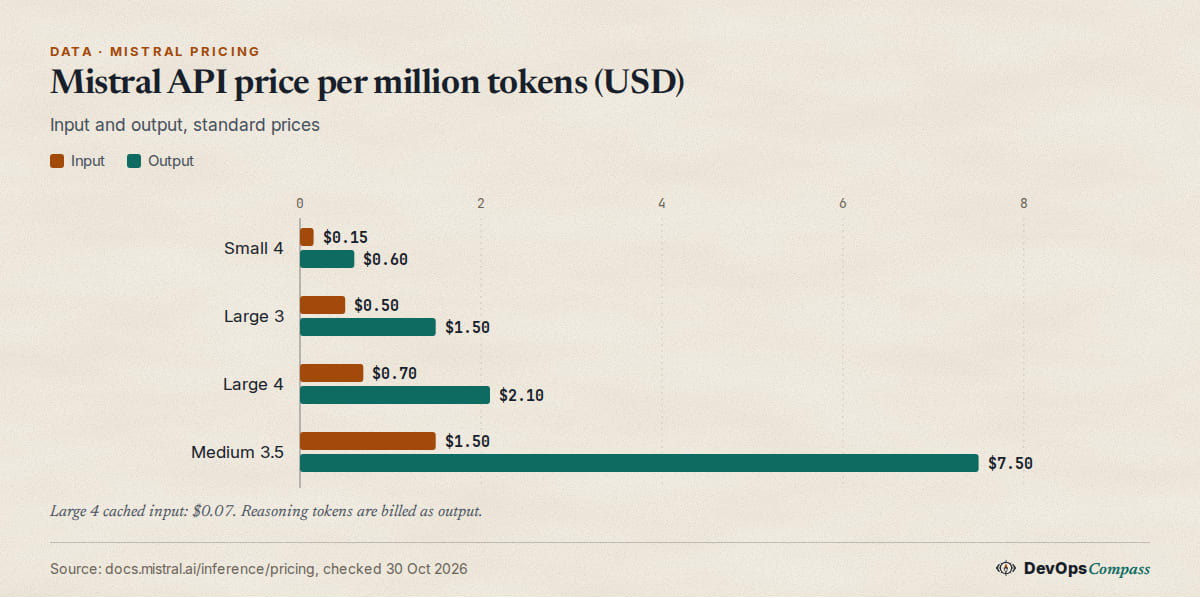
From the Mistral pricing page, per million tokens:
| Input | Cached input | Output | |
|---|---|---|---|
| Mistral Large 4 | $0.70 | $0.07 | $2.10 |
| Mistral Large 3 | $0.50 | $0.05 | $1.50 |
| Mistral Medium 3.5 | $1.50 | $0.15 | $7.50 |
| Mistral Small 4 | $0.15 | $0.015 | $0.60 |
A Hacker News user reported that the preview price was $1.36 input and $4.18 output, so the release price is roughly half. We could not check the old price page ourselves.
A worked example, our own arithmetic from the list prices: one million requests with a 2,000-token prompt and a 500-token answer is 2B input tokens and 500M output tokens. On Large 4 that is $1,400 + $1,050 = $2,450. On Large 3 it is $1,750, on Medium 3.5 $6,750 and on Small 4 $600. Large 4 defaults to high reasoning, and reasoning tokens are output tokens, so real bills will be higher. Use low or medium where you can.
Official benchmarks
Mistral's numbers, which we did not reproduce:
| Benchmark | Result | Note from Mistral |
|---|---|---|
| Artificial Analysis Coding Agent Index | 48% | effectively tied with GLM-5.3, with 47% fewer tokens per task |
| Terminal-Bench 4.0 | 41% | up from 28% in the preview |
| FrontierCode 2.0 (Cognition, private) | 19.7% | "leading open-weight models" |
| BrowseComp | 84.5% | up from 75% for an earlier checkpoint |
| Artificial Analysis Intelligence Index v5 | 26 | highest among Western open-weight models; Chinese open models score higher |
Mistral also reports a blind human-preference test (Surge Code) in which the model was preferred over GLM-5.3, Kimi K3 and DeepSeek V4.1 Flash and ranked behind only Claude Opus 5.5.
Is Mistral Large 4 really open weight?
It is weights-available, not open source in the Open Source Initiative sense. Mistral itself calls the licence "a modified version of the MIT license" and the Hugging Face metadata lists it as license: other. The extra condition (below) restricts one kind of business, and the OSI's open-source AI definition requires use "for any purpose without having to ask for permission". A Hacker News commenter made that point with a link to the definition, and others added that weights without training data are closer to a binary than to source code.
Practically, for most readers the label matters less than the clause. If you are not selling model access, the licence behaves like MIT.
What does the licence let you do?
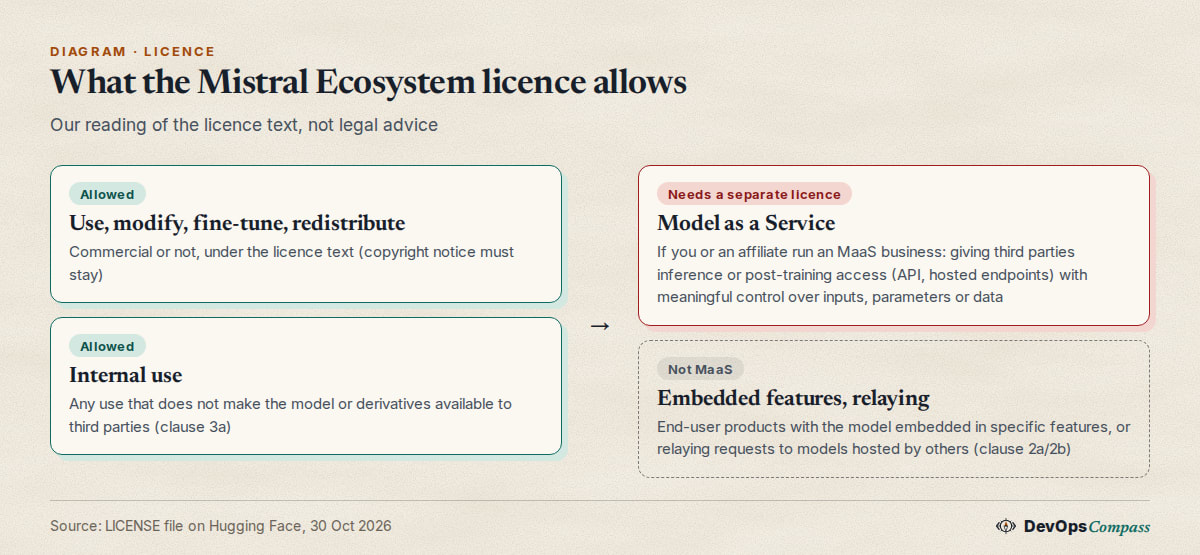
From the LICENSE file on Hugging Face:
- Allowed: use, copy, modify, merge, publish, distribute, sublicense and sell copies, run and further train the model, and create derivative works. The copyright notice must stay with copies.
- The catch (clause 2): if you or an affiliate operate a Model as a Service business, you must sign a separate commercial licence with Mistral before using the model or its derivatives "for any commercial purpose".
- Definition: Model as a Service means giving a third party access to the model or derivatives for inference or post-training (for example via API or hosted endpoints) in a way that lets them "exercise meaningful control over the inputs, parameters, or training data".
- Exceptions (clause 3): internal use that does not make the model available to third parties, and any use through Mistral's official products. The definition also excludes end-user products where the model is embedded in specific features, and merely relaying requests to models hosted by others.
Our reading, which is not legal advice: a company that fine-tunes Large 4 and uses it inside its own app, or inside a chatbot where users cannot set parameters, looks fine. A company that sells an inference API or fine-tuning service on top of it needs to talk to Mistral. The clause covers affiliates, so a cloud or platform company should ask a lawyer before building on it.
How much hardware does it take to run it yourself?
Mistral's model card does not state a minimum. Its own serving recipes use 8 GPUs (--tensor-parallel-size 8 for vLLM, --tp-size 8 for SGLang) and the card says that "for optimal performance" the Mistral API is recommended "if local serving is subpar". The sizes below are the weight files only, summed from the Hugging Face file listings; the KV cache for long prompts and runtime overhead come on top.

- FP8 original: about 1,061 GB (54 shards).
- NVFP4 (Mistral): about 610 GB.
- GGUF (ggml-org, for llama.cpp): IQ2_XXS 298 GB, Q2_K 381 GB, Q4_K_M 635 GB, Q8_0 1,115 GB, BF16 2,099 GB. Unsloth also publishes GGUFs, from UD-IQ1_S at 233 GB up to UD-Q4_K_XL at 605 GB.
Our arithmetic: eight 80 GB GPUs offer 640 GB, so even Q4_K_M or NVFP4 would barely fit the weights with almost nothing left for context. The README recipe sets --gpu-memory-utilization 0.85; on a 1,128 GB node (eight 141 GB GPUs) that is about 959 GB, below the FP8 file size, so the card's FP8 example implies larger-memory GPUs than that. We did not test any of this.
One Hacker News user asked whether a server with 4 x H200 (540 GB in their count) could serve it in 4-bit. By the file sizes above, a 610 GB NVFP4 checkpoint would not fit in 540 GB, so they would need a 2- or 3-bit quant, and replies suggested trying MoE offloading to CPU memory or quantizing it themselves. Only 49B parameters are active per token, which helps speed, but all 1T must still be stored somewhere.
For a laptop or a single 24 GB GPU, this is not the model. For small local models see our llama-server install and API guide.
How does it compare with Opus 5.5, GLM 5.3 and Kimi K3?
Google autocomplete shows people searching for exactly these pairings. All numbers below are vendor-reported or attributed:
- Vs Claude Opus 5.5: in Mistral's own blind preference test, only Opus 5.5 ranked higher. A Hacker News user, almindor, wrote that they use Opus 5.5 at work and it is "still much better".
- Vs GLM-5.3: tied on the Artificial Analysis Coding Agent Index per Mistral, with fewer tokens. The Intelligence Index v5 favours Chinese open models overall, as Mistral concedes.
- Vs Kimi K3: Mistral says Kimi K3 is ahead on FinWorkBench (73.3% for Large 4, second among open models) and behind in the human-preference test.
- Vs GPT and Claude prices: see our GPT-6.1 Terra pricing guide and Claude Haiku 5.5 guide for the closed-model side.
Is the 96.6% cyber refusal figure meaningful?
Mistral reports an average refusal rate of 96.6% on malicious cyber requests (JailbreakBench, StrongREJECT, AgentHarm) and 97.1% on the B3 agent-security benchmark. On its own, a refusal rate says nothing about false refusals of legitimate security work. A Hacker News user, 3form, made this point: a model that refuses randomly 96.7% of the time would score the same. Mistral's page also admits it sees "a potential for uplift to conduct real attacks" and is adjusting guardrails. Treat the figure as a safety claim to verify with your own red-team tests, especially since this is an open-weight model that anyone can fine-tune to remove refusals.
What users report
Reactions come from the Hacker News thread on the weights release (1,308 points on 29 October 2026). They are opinions, not verified by us. Reddit blocks our fetch tools, so we did not read it.
- Licence. maxloh argued that "open weight" is misleading for a licence with a business restriction; rcr-anti called it "weights available" and noted that it is a modified MIT licence that is not OSI-approved.
- Price. Topfi said the cut warrants a "major reassessment" of the model; oh_no replied that the benchmarks are "dreadful" and that cheaper smarter models exist.
- Quality. segmondy said Mistral's last two models did not live up to their self-reported evals; crimsoneer added that it is "fine" on their personal benchmark but behind the best Chinese and US open models.
- In production. d2kx reported using Large 4 through Mistral's API in an EU-based B2B app and being "quite happy".
- EU inference. traceroute66 pointed out that EU-only (regional) inference carries a 10% upcharge, per Mistral's documentation.
Our take
- Good fit: teams that need an open-weight model they can host in their own data centre for data-residency reasons, and companies in the EU that prefer a European provider. The API price is low for a model of this size.
- Not a fit: anyone who wants to run it on a workstation, anyone planning to resell it as an API, and anyone who needs the best coding results (Mistral itself ranks Opus 5.5 higher).
- Before adopting: run your own evals at
low,mediumandhighreasoning and measure cost per task, not list price; read clause 2 of the licence with a lawyer if you offer AI features as a platform. - Wait for: the technical report and independent benchmarks. Most numbers today come from Mistral and its partners.
What we did not test
- We did not call the API, download the weights or run any benchmark.
- Benchmark numbers are Mistral's, read from its announcement and model card, and some come from private or partner evaluations.
- File sizes are sums of the Hugging Face file listings on 30 October 2026; real GPU memory use will differ.
- The hardware reasoning and the cost example are our arithmetic, and the licence reading is not legal advice.
- Hacker News comments are opinions; we did not verify any user claim.
FAQ
How much does the Mistral Large 4 API cost?
$0.70 per million input tokens, $0.07 per million cached input tokens and $2.10 per million output tokens, according to Mistral's pricing page on 30 October 2026. Reasoning tokens are billed as output.
What is the Mistral Large 4 model ID and context window?
The docs list mistral-large-4-0, and the Hugging Face card says it is served as mistral-large-4. The context window is 1M tokens. The docs do not state a maximum output length.
Can I use Mistral Large 4 commercially?
Yes, under the Mistral Ecosystem Open-Weight License, unless you or an affiliate run a Model-as-a-Service business, in which case you need a separate commercial licence. Internal use and use through Mistral's own products are exempt.
Is Mistral Large 4 open source?
Not by the OSI definition. It is open-weight in the sense that you can download and modify it, but the licence has a business restriction and the training data is not published.
Is there a Mistral Large 4 GGUF for llama.cpp?
Yes. ggml-org and Unsloth publish GGUF files from about 233 GB to over 1,100 GB on Hugging Face. Even the smallest is far beyond a consumer GPU.
Is Mistral Large 4 on Ollama?
We did not verify an Ollama listing for it. The model card names vLLM, SGLang, Transformers and llama.cpp as supported ways to run it.
Does EU-only inference cost extra?
A Hacker News user cited Mistral's regional-inference documentation as adding a 10% upcharge. Check Mistral's current regional-inference page before you budget for it.
Sources
- Mistral: We're releasing the weights of Mistral Large 4 (29 Oct 2026; checked 30 Oct 2026).
- Hugging Face: Mistral Large 4 model card and LICENSE; ggml-org GGUF files and NVFP4 checkpoint (checked 30 Oct 2026).
- Mistral docs: Mistral Large 4 model page and pricing (checked 30 Oct 2026).
- Hacker News: weights release thread (29 Oct 2026).
- Open Source Initiative: Open Source AI definition.
- Google autocomplete suggestions for "mistral large 4" and related queries (30 Oct 2026).
Update log
- 30 October 2026: first version (weights release of 29 October; announcement, model card, licence, pricing, file sizes, Hacker News reactions).
Last verified: October 2026 (30 October 2026). Prices, licence terms and benchmarks can change; we will update this page and the log above.
Header image: Image: DevOpsCompass.
Comments
Post a Comment