
Gemini Keep Activity: Does Google Train on Your Chats?
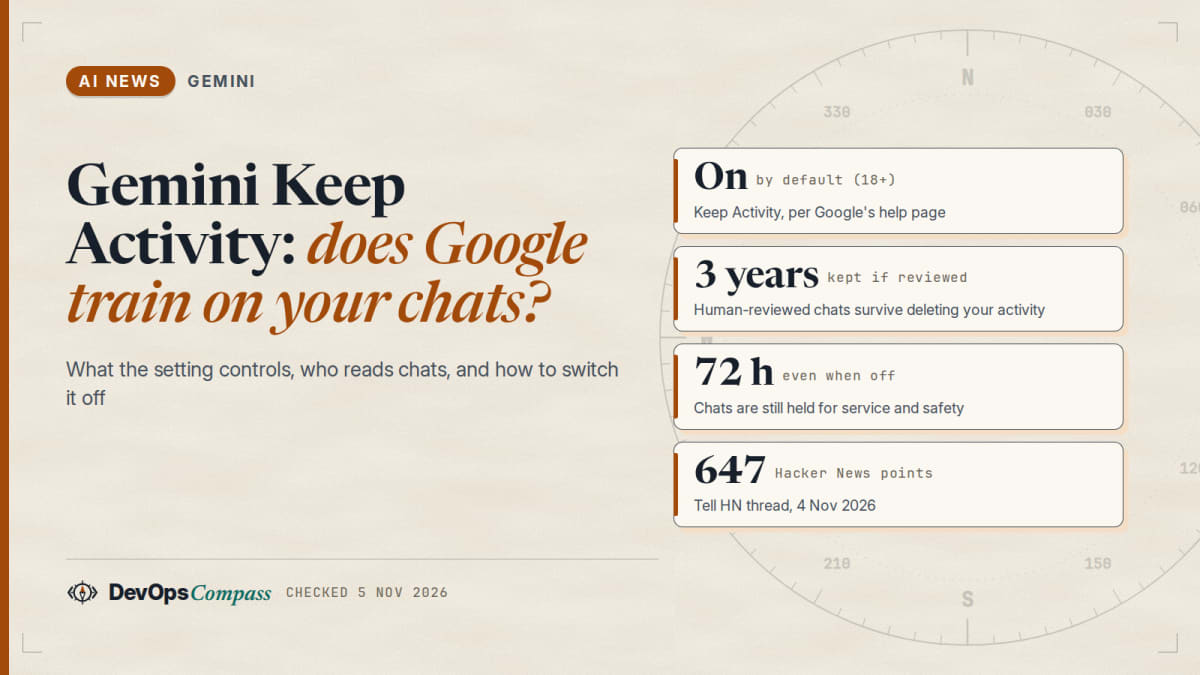
In short: a "Tell HN" post of 4 November 2026 (647 points) says Gemini trains on your saved chats, even on a paid plan, and that the only way out is to give up history. Google's own help pages say the same about the Keep Activity setting, which is on by default for adults. While it is on, your activity is used "to provide, develop, and improve its services (including training generative AI models)", and a subset of chats is read by human reviewers. Reviewed chats are kept up to three years and are not removed when you delete your activity. What to do: open Gemini, go to Settings & help, then Activity, and turn Keep Activity off, or use temporary chats; then expect 72 hours of retention and some lost features. Not new: Notebookcheck and TechRadar described the same rules in September and June. How this article was made: we read Google's Gemini privacy pages, the Gemini API terms, the Workspace privacy hub, Anthropic's and OpenAI's data pages, and the Hacker News thread. We did not change any account setting.
The questions behind the thread are: does Google train on my chats, does paying change that, can I keep history without training, who reads my chats, what does switching off cost, and do the API and work accounts follow the same rule? Official facts, user reports and our opinion are kept apart.
Official facts
Checked on 5 November 2026 against Google's Gemini Apps Privacy Hub (page updated 26 October 2026, notice dated 13 October 2026).
| Item | What Google says |
|---|---|
| Default | "If you're 18 or over, Keep Activity is on by default." (Manage & delete your activity) |
| Keep Activity on | Activity is used "to provide, develop, and improve its services (including training generative AI models)" and for protection "with the help of human reviewers" |
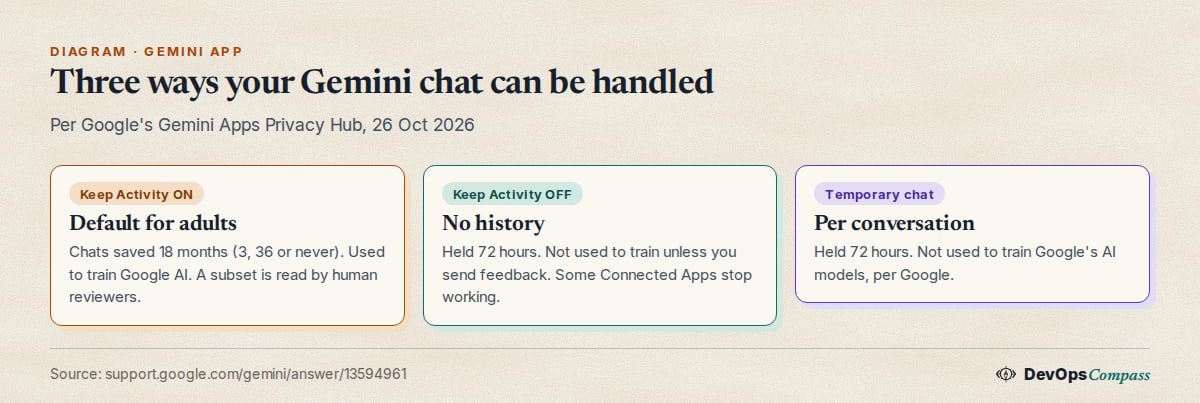
| Auto-delete | 18 months by default; you can choose 3 months, 36 months or never |
| Human review | "A subset of chats are reviewed by human reviewers (including Google's trained service providers)"; chats are disconnected from your account first |
| Reviewed chats | "Not deleted when you delete your activity. Instead, they are retained for up to three years" |
| Keep Activity off | Chats are saved 72 hours, "won't be used to train our AI models, unless you choose to send Google feedback" |
| Warning | "Please don't enter confidential information that you wouldn't want a reviewer to see or Google to use to improve our services" |
One more line matters: Gemini settings "don't control processing of your chats to create anonymized data to improve Google services", and even with Keep Activity off Google "still uses your chats to respond to you and help protect Google, our users, and the public, including with help from human reviewers."
Does paying for Google AI stop training?
The Hacker News post says no, and we could not find anything that says otherwise. The Privacy Hub treats the Gemini app as one product for everyone who is signed in with a personal account; the only mention of a paid plan is that Google collects "subscription related information" about you. There is no paid carve-out in the notice or in the Keep Activity help page. We did not test it, and we did not see a Google statement answering the paid-plan question directly (our search found none), so read this as "no exemption is documented", not as a guarantee about every plan and region.
The contrast Google does document is by product, not by price of a consumer plan: the paid Gemini API and Workspace accounts follow different terms (see below).
Can I keep history and stop training?
Not with the personal Gemini app, according to Google's pages. Keep Activity controls both at once: if it is on, chats are saved in your Activity and used to improve Google services; if it is off, future chats do not appear in Activity and are held for 72 hours only. Hacker News commenter bonoboTP put it this way: "You cannot keep your chat histories visible to yourself only." Another, therealmarv, wrote that the only way to get history without training is Gemini in Google Workspace. That is a user claim; the Workspace page below supports the no-training half of it.
Memory is a separate switch. The Privacy Hub says Gemini can personalise answers from chats in your Activity when Memory is on, and you can view and delete the "memory summary". Turning Memory off does not by itself stop Keep Activity.
Do humans read my Gemini chats?
Some do. Google says a subset is reviewed to assess whether answers were "low-quality, inaccurate, or harmful", to suggest better responses and to enforce its terms. Reviewers can be Google's service providers. Chats are disconnected from your account before they go to those providers, which is also why deleting your activity cannot reach them: the Hub says reviewed chats, plus related data such as language, device type, location info or feedback, stay for up to three years.
Two cases extend this. If you send thumbs-up or thumbs-down feedback, Google keeps the last 24 hours of chat and any content in it for review, even with Keep Activity off. And chats can be reviewed for safety whatever your setting, per the line quoted above. On Hacker News viraptor argued that this is normal for any chatbot provider and partly about legal exposure; jameslk replied that the page lists wider purposes, such as improving models.
Are temporary chats safe?
Safer, with limits. Google states: "Temporary chats are not used to train Google's AI models", and they are "not used to improve Google AI with help from human reviewers". They are still stored with your account for 72 hours, using the last 24 hours as context, and Google still uses them "to protect Google, our users, and the public". The feedback rule above applies too. So they cut training and routine review; they do not make a chat invisible to Google.
Are Gemini Live audio and photos used?
Audio, Gemini Live video and screen shares are not used to improve Google services by default; that is a separate setting, off by default, and it needs Keep Activity on. Other Live content is different: transcripts of Live chats and uploads you share with Live fall under Keep Activity and are used to improve services when it is on. Google says photos you share with Gemini from a gallery app follow the same notice. Data from Connected Apps (Gmail, Drive, Photos and others) is used to personalise Gemini and, per Google's Connected Apps page, "to improve Google services, including training generative AI models".
What breaks when Keep Activity is off?
According to Google's activity page, only these apps stay available with it off: Device assistance, Gemini Notebook, Messages, Phone and WhatsApp. Other Connected Apps such as Google Workspace are unavailable until you turn it back on, and remote-browser tasks need it on. Gems you create are still saved, but chats with them are not.
A Pixel user, richrichardsson, reports the cost in practice: with the setting off, "Hey Google, remind me at 7pm" stopped working, and Gemini said it could not do anything with the phone unless chat history was on. We did not test this on a device. Several other commenters said Google does the same with YouTube watch history and Maps location.
Gemini API, AI Studio and CLI
These follow different terms. In the Gemini API terms:
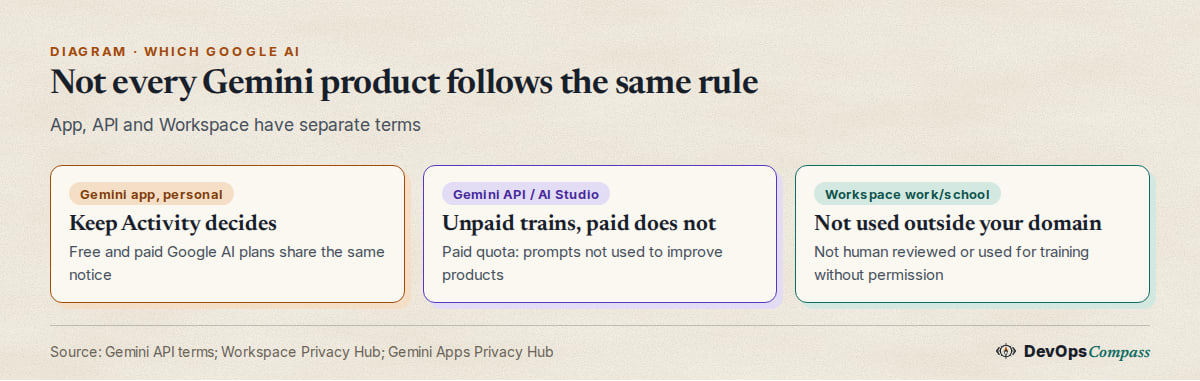
- Unpaid services (free quota in the API, and AI Studio without billing): Google uses what you submit to improve its products, and "human reviewers may read, annotate, and process your API input and output". Data is disconnected from your account and API key first. "Do not submit sensitive, confidential, or personal information."
- Paid services (a Cloud project with active billing): "Google doesn't use your prompts ... or responses to improve our products." Prompts and responses are logged for a limited time to detect abuse.
- EEA, Switzerland and UK: the paid terms apply to every service, including free quota.
The Gemini CLI privacy page says the rules depend on how you sign in: a Google account uses the Gemini Code Assist terms, an API key uses the unpaid or paid API terms, and Vertex uses Google Cloud terms. We did not read the Code Assist notice itself, so we cannot say what it permits for training.
Work and school accounts
Google's Workspace privacy hub (updated 6 October 2026) says Gemini content "is not human reviewed or otherwise used for Generative AI model training outside your domain without permission". The Gemini notice itself says that a work or school account "may be subject to different data handling terms".
How does this compare with ChatGPT and Claude?
We read only what our tools could reach. Treat this as a pointer, not a full comparison.
- Claude (consumer): Anthropic's help page (dated 16 March 2026) says chats are used to improve models if you allow it, if a conversation is flagged for safety review, or if you opt in separately. Incognito chats are not used. So, unlike Gemini, the choice is a model-improvement setting separate from history. Commercial and API use is covered by separate terms. See also our post on Claude's model switching.
- OpenAI API: OpenAI's docs say data sent to the API is not used to train models unless you opt in, with abuse-monitoring logs kept up to 30 days by default.
- ChatGPT (consumer): OpenAI's help articles returned an error for our tools, so we could not read them. A Hacker News commenter, EbNar, wrote that ChatGPT has an "improve models for everyone" switch even when history is on; that is unverified here. For the other side of OpenAI's plans, see our post on ChatGPT and Codex shared limits.
Is this new?
No. The Hacker News post is new (4 November), the rules are not. Notebookcheck wrote on 5 September 2026 that Keep Activity is on by default for adults and reviewed chats are kept for up to three years, and TechRadar reported on 2 June 2026 that turning it off has a downside. We cannot tell from public pages exactly when each sentence of Google's notice was added. The Privacy Hub shows "Last updated: October 26, 2026" for the page and October 13 for the notice, so it changes often; check it yourself.
How do I turn off Keep Activity?
From Google's activity help page, on a computer:
- Go to gemini.google.com.
- Click Settings & help, then Activity.
- At the top, click Turn off (or Turn off and delete activity).
For one conversation, start a temporary chat instead. To shorten retention without switching off, change auto-delete in Gemini Apps Activity to 3 months. Remember what the pages say stays: 72 hours of stored chats, any chat already reviewed, and anything you send as feedback. We followed these steps in Google's text only; we did not change an account.
What users report
All of this is opinion or experience from the Hacker News thread (647 points, 55 top-level replies when we read it). We could not reach Reddit.
- The original claim. jameslk: "I learned this too late, thinking that having a paid subscription = not being turned into the product."
- Paid is not exempt, in commenters' view. officeplant and WarmWash said the paid price does not buy privacy, and WarmWash argued the real confidential tier is the API.
- Feature lock-in. richrichardsson and shostack described features on Pixel phones that stopped working with history off.
- Everyone does it. fny wrote that human review happens at all frontier providers even with tracking off, and linked press coverage. We did not check those links.
- Retention is for liability. viraptor said human review and retention are expected for chats that may create liability; geraneum disagreed that this needs consent in the terms.
- Cancellations. kekqqq and EbNar said they cancelled or dropped Gemini Pro; these are personal choices.
Our take
- If you type anything confidential, turn Keep Activity off or use temporary chats. Google itself asks you not to enter it. This costs history and some phone features, which is the real trade.
- If you need history without training, look at the other products. A personal Gemini account does not offer it according to Google's pages; Workspace or a paid API project is the documented route, with its own cost and limits.
- Do not read this as a scandal about a change. It is a default-on setting that has been documented for months, explained badly in the app. The fair criticism is that paying for Google AI does not visibly change it.
- Review what Connected Apps can see. Gmail, Drive and Photos data can enter the same pipeline once connected. Our Postman plugin post shows why access you did not choose deserves a check.
What we did not test
- We did not change Keep Activity, use temporary chats, or sign in to a paid Google AI plan.
- We could not confirm whether any paid plan has different terms; no document we read says so.
- We did not read the Gemini Code Assist notice, or OpenAI's ChatGPT help pages (blocked).
- We did not verify Pixel feature loss or any commenter's claim.
- Google's pages change often; wording above is from 5 November 2026.
FAQ
Does Gemini train on your chats?
Per Google, yes while Keep Activity is on, which is the default for adults: activity is used to improve services, "including training generative AI models". With it off, future chats are not used unless you send feedback.
How do I turn off Gemini Keep Activity?
On gemini.google.com click Settings & help, then Activity, then Turn off. Chats are still held 72 hours, and some Connected Apps stop working.
Do humans read my Gemini chats?
A subset, according to Google, including trained service providers. Chats are disconnected from your account first, and reviewed chats are kept up to three years, even if you delete your activity.
Does paying for Gemini stop training?
We found no paid-plan exemption in Google's notice. The paid Gemini API and Workspace follow different terms: prompts are not used to improve products on paid API quota.
Are Gemini temporary chats private?
Google says they are not used to train its models, but they are stored with your account for 72 hours and can still be used for safety. Feedback you send is reviewed.
Does the Gemini API train on my data?
On unpaid quota, yes: Google uses it to improve products and humans may read it. On paid quota, Google says it does not use prompts or responses to improve products.
Does Gemini CLI train on my data?
It depends on how you sign in. A Google account follows Code Assist terms; an API key follows the unpaid or paid Gemini API terms; Vertex follows Google Cloud terms.
Related guides
- Why Claude switched models: Opus 5.5 fallback explained for another case where a vendor setting changes what you get.
- ChatGPT and Codex shared limits: what changes in December for how a plan's terms can change under you.
- Postman plugin in Claude Code and Codex: how to remove it for checking what tools can access.
Sources
- Google: Gemini Apps Privacy Hub, Manage & delete your activity in Gemini Apps, About personalization with Connected Apps.
- Google: Gemini API additional terms, Generative AI in Google Workspace Privacy Hub, Gemini CLI terms and privacy.
- Anthropic: Is my data used for model training?. OpenAI: Data controls in the OpenAI platform.
- Press: Notebookcheck, 5 Sep 2026; TechRadar, 2 Jun 2026.
- Hacker News: Tell HN: Gemini trains on chat history, even for subscribers (4 Nov 2026).
- Google autocomplete suggestions for "does gemini train on your data", "gemini keep activity", "gemini human reviewers" and "gemini temporary chat" (5 Nov 2026).
Update log
- 5 November 2026: first version, from Google's Gemini, API and Workspace privacy pages and the Hacker News thread. We will update it if Google changes the notice or answers the paid-plan question.
Last verified: November 2026 (5 November 2026). Vendor settings and terms change; we will update this page and the log above.
Header image: Image: DevOpsCompass.
Comments
Post a Comment