
Edge0-145B: Does a 145B Model Fit a 29GB Laptop?
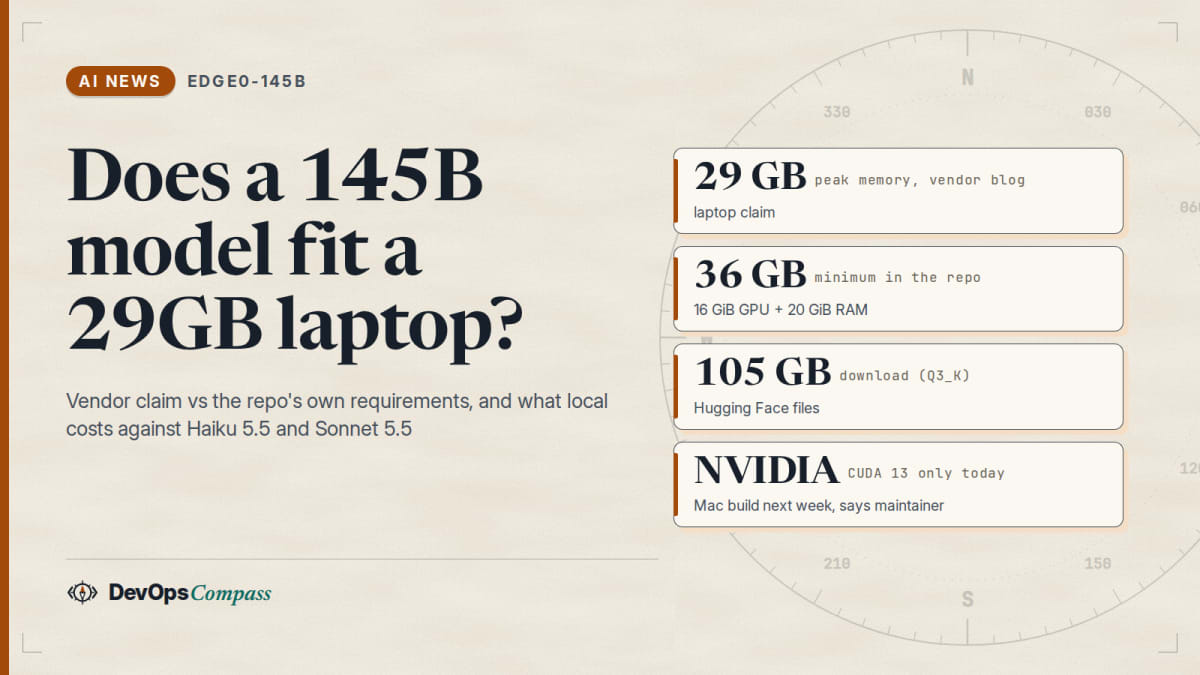
In short: on 12 November 2026 the company Edge0 released Edge0-145B and Edge0-120B, open-weight models that it says bring cloud-level coding to a personal computer, with "29GB peak memory" and "80+ tokens/s" on a laptop. Its own GitHub page says something narrower: Linux or Windows, an NVIDIA GPU with CUDA 13, at least 16 GiB of GPU memory and 20 GiB of system memory, and a 105 GB download. There is no Mac or AMD build yet. Our thesis: it is a real option for people who already own a 24 GB NVIDIA card and 64 GB of RAM, but it is not a laptop model today, and it saves money only against Sonnet-class prices, not against Claude Haiku 5.5. Every benchmark in the launch is Edge0's own. How this article was made: we read Edge0's blog, GitHub docs, licence and Hugging Face files, the Hacker News thread and the GitHub issues, and did the cost sums ourselves. We did not download or run the model.
The questions this answers: does a 145B model really fit in 29GB, what hardware does it need, does it run on a Mac or AMD, is it open source, is it just Qwen, and is it cheaper than an API?
Official facts
Checked on 14 November 2026 on Edge0's blog, its GitHub repository and Hugging Face.
| Item | Fact | Source |
|---|---|---|
| What it is | Edge0-145B (145B parameters, about 10B active per token) and Edge0-120B, "latent mixture-of-experts" models for local coding and agent work | Edge0 blog |
| Base model | Derived from Qwen3.8-Flash-Next, run on edge0-strata, a fork of the Strata engine |
Model page |
| Release | 12 November 2026 (blog); weights on Hugging Face as Edge0-145B-q3k and Edge0-145B-NVFP4 |
Hugging Face |
| Context | 128K to 256K tokens; 256K maximum, int8 KV cache | Model page |
| Weights | Q3_K build 40.81 GiB, NVFP4 build 47.79 GiB; the full Hugging Face folder of the Q3_K build is 105.4 GB | Model page, file listing |
| Platforms | Linux or Windows with an NVIDIA GPU and CUDA 13 | Requirements |
| Minimum memory | At least 16 GiB of GPU memory and 20 GiB of system memory | edge0-infer docs |
| Licence | Edge0 Community Model License 1.0 for the Edge0 parts; the Qwen licence still applies to the base | Licence text |
| Known limits | Queues concurrent requests, and results at temperature 0 are not bit-for-bit repeatable | edge0-infer docs |
Edge0's own benchmark claims, all from "internal evaluations" that the company says will be backed by a technical report later: 64.6 on DeepSWE 1.1, 86.52 on Terminal-Bench 2.1, 90.4 on GPQA-Diamond, 80.6 on IFBench, 35.4 on HLE and 79.3 on AA-LCR. It compares itself with Qwen3.8-Flash-Next, DeepSeek-V4-Flash-0731 and Claude-Opus-4.6 at maximum effort, and writes that the memory figures for those rivals are estimates that "remain to be measured".
What hardware does Edge0-145B really need?
The launch post says the model "runs locally on a compatible laptop, with reported peak memory of 29GB and decoding above 80 tokens/s" and "enabling local use on a 48GB laptop". The documentation gives more detail, and the numbers do not all describe the same thing:
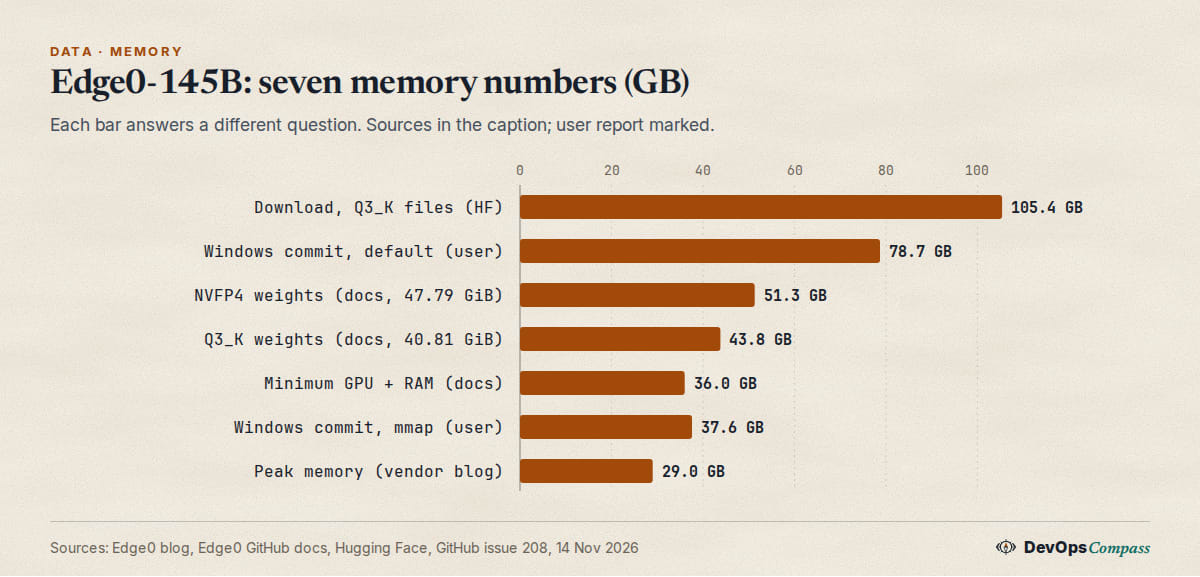
- 29 GB is the vendor's measured peak memory on its test machine. It does not say whether that is GPU memory, system memory or both.
- 36 GB is the documented minimum: 16 GiB of GPU memory plus 20 GiB of system memory. Edge0's repository reports 36.8 tokens per second chat decode in that constrained test, using an RTX 5090 limited by cgroups.
- 40.81 GiB (Q3_K) or 47.79 GiB (NVFP4) is the size of the expert weights. The engine keeps a few thousand experts on the card and streams the rest from system memory.
- 105 GB is what you download for the Q3_K build, because it also carries a 51.2 GB memory-mapped n-gram embedding table that is read from disk as needed.
- A Windows user's report (below) measured 78.7 GB of committed memory with the default settings on a 64 GB PC.
So the honest answer to "does it fit in 29GB?" is: the active working set may be small, but you need an NVIDIA GPU with at least 16 GiB, 20 GiB or more of RAM, and about 100 GB of fast disk. That is a gaming desktop, not a typical thin laptop.
Does Edge0-145B run on a Mac, AMD or Windows?
- Linux and Windows with NVIDIA: yes, CUDA 13. The README's platform table lists the 35B phone model for macOS, Linux and Windows, and the 145B and 120B models for NVIDIA only.
- Mac: not yet. The repo shows Apple M2 Ultra speeds (60.9 tokens/s chat decode) but says these "do not establish macOS release availability". In GitHub issue 201 a maintainer wrote on 14 November that the Apple Silicon build "ships next week". That contradicts the blog's "day-one support covers macOS" line, which several Hacker News readers noticed.
- AMD: not yet. In issue 197 a maintainer says an AMD HIP pull request is under review.
- Windows caveats: issue 207 reports that Windows 11 Smart App Control blocks the unsigned executables, and the engine has to be built from source.
Is Edge0-145B open source, and can you use it at work?
Not "open source" in the usual sense. The inference framework is Apache 2.0 (its README badge) and edge0-strata is a fork of an MIT project. The model weights use the Edge0 Community Model License 1.0, and Hugging Face labels it "other". A Hacker News commenter put it as "open weights, not open source"; another said the licence is too restrictive even for that label.
Our reading of the text, which is not legal advice:
- Allowed without asking: personal use, research, internal use by a business, using it to do paid work, and selling what it outputs.
- Needs a separate commercial licence: selling or renting access to the model, running a paid model service, and offering an independent commercial coding or office assistant, "whether inference is hosted or runs on a user's device".
- The Qwen licence still applies and Edge0 says its licence does not replace it.
If you are building a paid coding tool on top of it, read section 4 before you start. If you use it inside your own company, the licence looks friendly.
Is Edge0-145B just a Qwen fine-tune?
Edge0 does not hide it in the repository, but the launch post leads with its own branding. The model page says it is "derived from Qwen3.8-Flash-Next", the Hugging Face tags list Qwen/Qwen3.8-Flash-Next as base model, and the engine is a fork of Strata. The blog describes training "in its on-device architecture from the outset", and the repository describes changes on top of the base: a latent compression of the experts, shared projection matrices and a draft head for speculative decoding.
That is normal work in the open-weights world. What matters for you is that the quality claims are about a modified and quantised Qwen derivative, so the Qwen licence terms and Qwen's known strengths and weaknesses carry over, and results can differ from the plain base model.
What users report
The Hacker News thread had 343 points and 104 comments on 14 November. We could not read Reddit with our tools, so nothing here comes from Reddit. These are individual claims that we have not verified.
- Fine-tune and marketing. Aurornis says the repo shows it is based on Qwen3.8-Flash-Next and Strata, and that "it's weird to see this marketing web page imply that it was all new and novel work". kimixa notes the Hugging Face page lists Qwen as the base and suspects the baselines were compared in a quantised form.
- Open-weights wording. Zetaphor writes "this is not open source, this is open weights", and hedora replies that the licence is too restrictive even for open weights.
- Mac confusion. phillennium asks whether anyone has figured out the macOS situation, since the blog promises it and the released files are CUDA only. kjjohnsen says a ported build gets "about 50 tok/s on an m5 max at nvfp4"; we could not check it.
- Skepticism. fesoliveira is excited if third-party testing confirms it, but doubtful at this size; daemonologist criticises the page for "communicating as little as possible"; d--b says the Opus 4.6 comparison is outdated.
- Positive. rybosome says Terminal-Bench scores often track real agent work and this score is about that of a model they use for complex tasks, and thinks it is "worth an evaluation".
- Hardware reality. igleria read the requirements and concluded that a 16 GB GPU with 32 GB of RAM was not enough to bother; utopiah asks whether normal people own a 64 GB laptop at all.
What do users measure on their own PCs?
GitHub issues from the first day show how the numbers move on real machines:
- RTX 4090, 64 GB RAM, Windows. In issue 208 Have-Purple built the engine from source and reported chat decode of 61.3 tokens/s and agent decode of 75.3, against Edge0's published 69.9 and 91.7 for the same card, with prefill about two thirds of the published figure. With default settings the engine committed 78.7 GiB of memory on a 64 GiB PC, and during tuning the machine hit a 39 GB pagefile peak and froze. Using
--mmap-expertsbrought commit to 37.6 GiB but cut cold prefill speed by more than half. A maintainer replied that the model is about 46 GiB at 64K context and that 64 GiB "really is enough", with a different setting to try. - RTX 5070 Ti, Windows. Issue 206 reports that some short prompts appeared corrupted and coding results were well below the plain Qwen quant; another user could not reproduce it on an RTX 4090.
- Other cards. Issues show prefill hangs on RTX PRO 6000 and stalls when splitting layers over two older cards, all open on 13 and 14 November.
These are day-one bug reports on a release that is two days old. They show that the headline speeds are reachable, with the right memory settings and the right card.
Can you trust the benchmarks?
Treat them as claims, not results, for three reasons: (1) they come from "Edge0's internal evaluations" with the setup "being released with our technical report"; (2) the Claude figure is Opus 4.6, while Anthropic's current price list already has Opus 5.5 and Fable 5.2, and Claude has no DeepSWE score in the table; (3) the memory column for rivals is "estimated for standard 4-bit deployment" and not measured. Note that in Edge0's own table Qwen3.8-Flash-Next scores higher than Edge0-145B on GPQA-Diamond (91.7 against 90.4), so the claim is "comparable", not "better".
Is running it locally cheaper than Haiku 5.5 or Sonnet 5.5?
Edge0's post says local inference "incurs no corresponding cloud-model token or API fees", and adds that "hardware and electricity still cost money". Here is the arithmetic the post leaves out. Our assumptions: one agent task of 100,000 input tokens and 10,000 output tokens; the Edge0-published RTX 4090 Q3_K speeds (2,042 tokens/s prefill, 69.9 tokens/s decode); a whole PC drawing 500 W under load; electricity at $0.15 per kWh; and a $2,500 machine, which is our placeholder and not a quote. API prices are from Anthropic's price list on 14 November.
| Time per task | Cost per task | Per 1,000 tasks | |
|---|---|---|---|
| Edge0-145B on the 4090 PC, electricity only | 192 s | $0.004 | $4 |
| Claude Haiku 5.5 ($0.10 in / $0.50 out) | n/a | $0.015 | $15 |
| Claude Sonnet 5.5 ($2 in / $10 out) | n/a | $0.30 | $300 |
| Claude Opus 5.5 ($4 in / $20 out) | n/a | $0.60 | $600 |
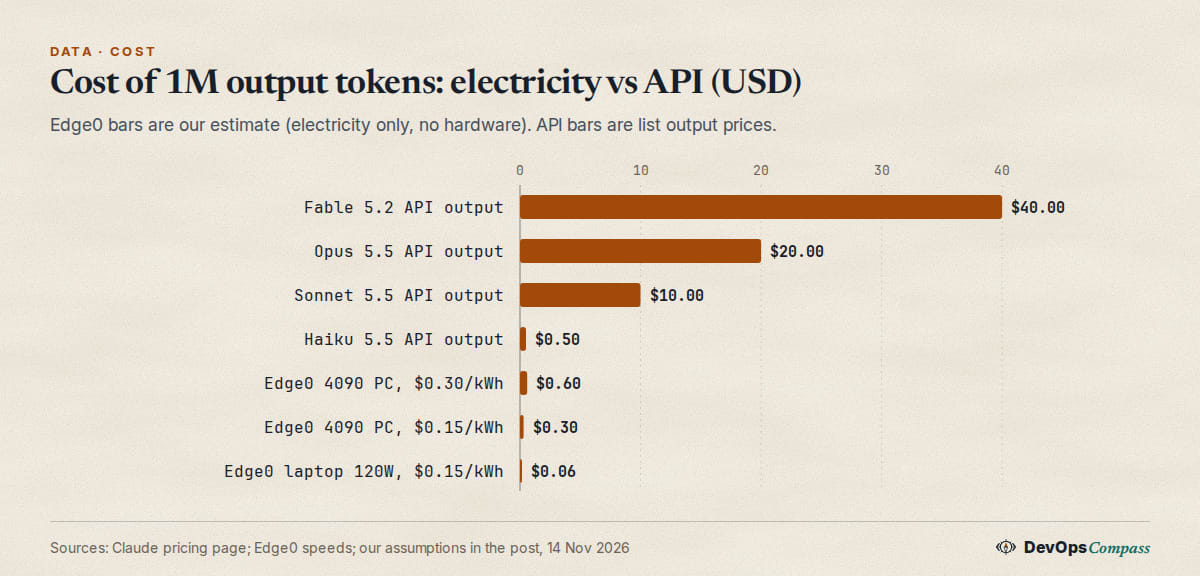
On electricity alone local wins against every API row. The catch is the machine. At $2,500, divided by what each API would have cost minus the electricity:
- Against Sonnet 5.5 you break even after about 8,400 tasks, which is 19 days of non-stop work at 192 seconds each.
- Against Opus 5.5, about 4,200 tasks, or 9 days non-stop.
- Against Haiku 5.5, about 227,000 tasks, which is 505 days non-stop. At the vendor's laptop figure of 80 tokens/s and 120 W, electricity per task falls to about a tenth of a cent, but the Haiku break-even still stays near 180,000 tasks, because the machine price dominates.
Double the electricity price to $0.30 per kWh and the Sonnet break-even barely moves, while the Haiku one grows to about 360,000 tasks. Add the quality question and it gets harder: the API rows are models you can call from a phone with no setup, with a context window and tool support that are documented.
Our take
Thesis: Edge0-145B is a useful release for people who already own a 24 GB NVIDIA card and 64 GB of RAM and want a private, offline coding model. For everyone else the "29GB laptop" headline is ahead of the software, and the "no token fees" argument holds only against Sonnet-class and Opus-class prices.
What I conclude from the sources:
- The headline and the requirements disagree. A launch post that sells a laptop and a repository that requires CUDA 13 and an NVIDIA card are not the same product. Until the Apple Silicon build ships, which a maintainer says is next week, Mac owners cannot test any of it. Check the date on that promise before you plan around it.
- The money argument is weaker than it sounds. At about 4 hours of generation per million output tokens, a 4090 PC is cheap to run but slow to pay back. Against Claude Haiku 5.5 at $0.10 / $0.50 it never really does. Only teams that would otherwise run large Sonnet or Opus bills, with steady daily volume, save real money. The value of local is privacy, offline work and no rate limits, not price.
- Quality is unproven. Every number is the vendor's, compared with a two-generation-old Claude model. The first user reports are mixed: speeds near the published ones, memory surprises on 64 GB Windows, and one report of corrupted short prompts on a newer card. That is normal for day two, but it means you should not move production work on a launch post.
- Read the licence before you build on it. Internal use is fine, but a paid coding assistant built on it needs a separate deal with Edge0 (and may need one from Qwen).
What I would do:
- If you own an RTX 4090 or 5090 and 64 GB of RAM, try it on a non-critical repository next week once the first independent benchmarks exist. Use the Q3_K build, keep 150 GB of free disk, and watch memory on Windows.
- If you use a Mac, wait for the Apple Silicon release and independent numbers. Our earlier guides on what fits in 8, 16 and 32 GB of RAM and on Ollama coding models by VRAM cover models that run today.
- If you pay Anthropic or OpenAI for agents, compare local only with the model tier you actually use. Our posts on Haiku 5.5 prices and on a decider versus Sonnet show how to work out cost per task first.
- If you build products, ask Edge0 about the commercial licence now, not after launch.
Who should care: owners of high-end NVIDIA PCs, privacy-minded teams with a strict data policy, and anyone tracking whether big open-weight models are shrinking to local hardware. Who can wait: laptop and Mac users, AMD owners and anyone happy with an API.
What we did not test
- We did not download the 105 GB model, build the engine or run any inference. All speed, memory and quality figures are from Edge0's documents or from named users.
- We did not check the benchmarks, the Qwen base model's licence text, or whether the Edge0 licence is enforceable. Our licence summary is a plain-language reading, not legal advice.
- The cost table is our arithmetic from published speeds, an assumed 500 W and $0.15 per kWh, and a placeholder $2,500 PC price. Real agent tasks vary in size and use caching, which this ignores.
- We did not compare answer quality with Haiku 5.5, Sonnet 5.5 or the plain Qwen3.8-Flash-Next.
- We read the first two days of GitHub issues; they will change. Every Hacker News statement is the commenter's claim.
FAQ
What is Edge0-145B?
An open-weight coding and agent model with 145 billion total parameters, about 10 billion of them active for each token, released by Edge0 on 12 November 2026. It is derived from Qwen3.8-Flash-Next and runs on Edge0's own engine, built for a single NVIDIA GPU with system memory as a second tier.
How much memory does Edge0-145B need?
Edge0's documentation asks for at least 16 GiB of GPU memory and 20 GiB of system memory, which is a 36 GB minimum. The Q3_K weights are 40.81 GiB and the download is 105.4 GB. The "29GB peak" in the launch post is a measured peak on the vendor's own test machine.
Can I run Edge0-145B with Ollama, llama.cpp or a GGUF file?
Not in the usual way. The models run on edge0-strata, a fork of the Strata engine, started through edge0-infer serve or chat, and the folders on Hugging Face are multi-file model packs, not single GGUF files. A Hacker News reader complained about exactly this. We found no Ollama support in the documents we read.
Does Edge0-145B work offline?
Yes, once the files are downloaded. Edge0 says core capabilities work offline without an account or quota, though tasks that need current information still need a connection.
Is there an iOS app for the Edge0-35B phone model?
Edge0's repository lists engines for iOS, macOS, Android and Windows for the 35B model, with chat app examples. We did not install any of them. The 145B and 120B models are not phone models.
Can I use Edge0-145B commercially?
Often yes, with limits. The licence allows internal business use and selling outputs, but requires a separate commercial licence to sell or host access to the model or to ship a paid coding or office assistant built on it. The Qwen licence also applies. Read the licence text before you build a product.
Related guides
- Gemma 4 and Qwen3.6 by RAM: what fits in 8, 16 and 32 GB for models that run on ordinary hardware today.
- Ollama models for coding: what fits in 8, 16 and 24 GB VRAM for the same question in Ollama terms.
- Mistral Large 4 open weights: licence, price, hardware for another open-weight release read the same way.
- Claude Haiku 5.5 API: price, effort levels, migration for the cheap API baseline used above.
Sources
- Edge0: Introducing Edge0-145B (12 Nov 2026).
- Edge0 GitHub: Edge0 145B and 120B model page, edge0-infer 145B documentation and repository README.
- Hugging Face: Edge0-145B-q3k and Edge0-145B-NVFP4, including the Community Model License 1.0.
- GitHub issues: 201 (Mac), 197 (AMD), 208 (RTX 4090 report), 206 (RTX 5070 Ti), 207 (Windows).
- Anthropic: Claude API pricing.
- Hacker News: thread 50475713.
- Google autocomplete suggestions for "edge0-145b" and "edge0 35b" (14 Nov 2026).
Update log
- 14 November 2026: first version, from Edge0's blog and GitHub documents, the licence, Hugging Face file listings, the first GitHub issues, Anthropic's price list and the Hacker News thread. We will update it when the Apple Silicon build ships, when AMD support lands, or when independent benchmarks appear.
Last verified: November 2026 (14 November 2026). Releases change fast; we will update this page and the log above.
Header image: Image: DevOpsCompass.
Comments
Post a Comment