
Claude Duet: What It Is, Waitlist, Pricing and Limits
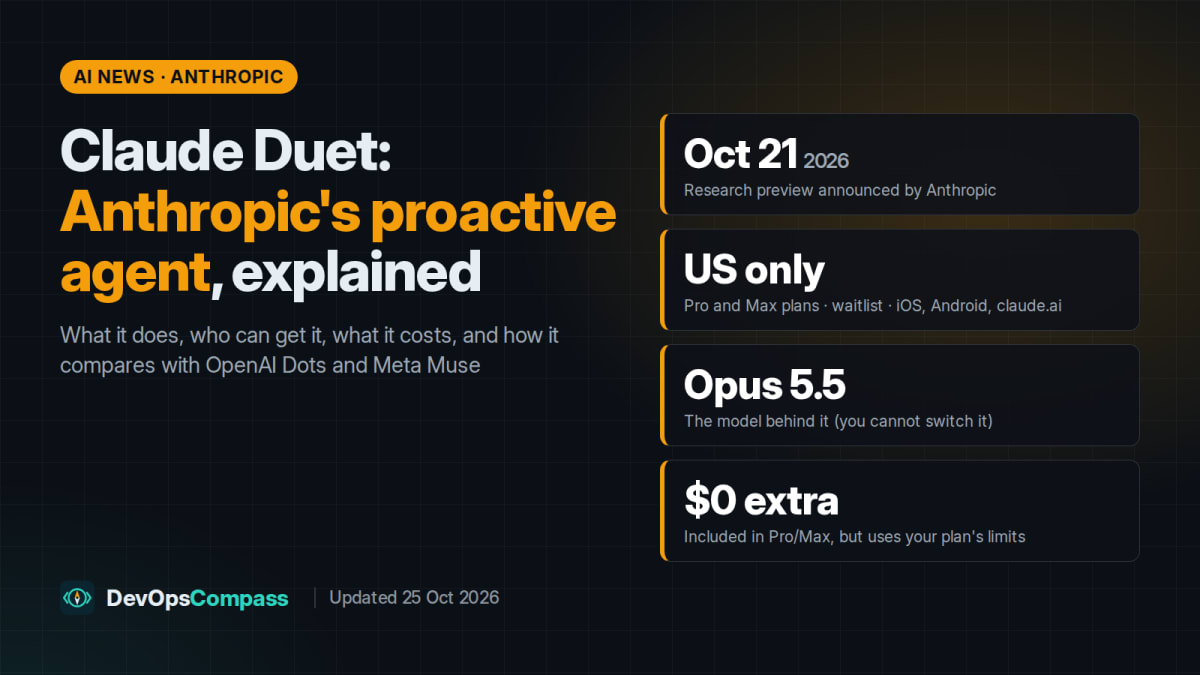
In short: Claude Duet is a proactive agent that Anthropic announced on 21 October 2026 as a research preview. Instead of waiting for you to open a chat, it watches the apps you connect (email, calendar, Slack, accounting tools), sends a morning brief, drafts replies and documents, and runs longer tasks on its own cloud computer. It runs on Claude Opus 5.5. Access is waitlist-only for US Pro and Max subscribers, on iOS, Android and claude.ai. There is no extra charge, but its background work counts toward your plan's usage limits. It always asks before it sends, pays, signs or deletes anything.
Anthropic was the last of the big AI labs to ship an "always-on" personal agent this autumn: Meta launched Muse on 8 September and OpenAI launched Dots at DevDay on 29 September. This article keeps three things apart: official facts from Anthropic's own pages (the announcement, the product page, the help center and the safety article from 23 October), what users report in the first days after launch (linked, not verified by us), and our take. How this article was made: it is a news roundup. We have not used Claude Duet: it is US-only and invite-only.
Official facts
Everything in this section comes from Anthropic's published pages, checked on 25 October 2026.
What is Claude Duet?
Claude Duet is a separate app from the normal Claude chat. You talk to it in one continuous thread, by text or voice, the way you would message a colleague. The difference from regular Claude is the direction of the conversation: regular Claude answers when you ask, while Duet reaches out to you.
According to Anthropic, a typical day looks like this:
- Morning brief. Each morning Duet reviews your email and calendar and sends a short summary of what matters. It may already start first steps, such as drafting replies.
- Check-ins. It checks your connected accounts every few hours and messages you only when something needs you. It also follows up on threads that went quiet.
- Delegated tasks. You can hand it larger jobs: schedule meetings, find unpaid invoices, prepare payroll for review, get a contract ready to send, or build a brief, a deck or a dashboard. A Tasks tab shows active work and items waiting for your input. Only you can mark a task as complete.
- Works while you're away. Duet runs on its own virtual machine with its own browser, so your phone or laptop does not need to stay on. You get a notification when a task is done or needs review.
It starts with your existing Claude memory, skills and connected apps, so it does not begin from zero. Anthropic says it has access to more than 6,000 connectors and plugins in the Claude Marketplace.
Who can use it, and how to get access
The research preview is limited. You need all three of these:
- A Claude Pro or Max plan (Team and Enterprise plans are not supported yet).
- A Claude account in the United States.
- An invitation from the waitlist.
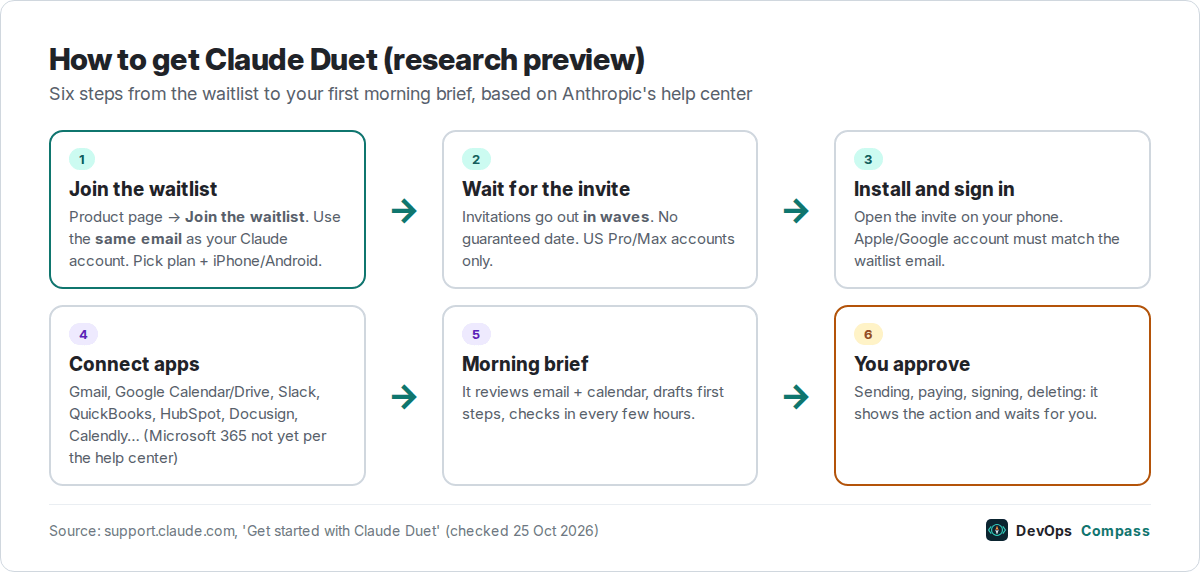
The steps, as described in Anthropic's help center:
- Open the Claude Duet product page and select Join the waitlist.
- Enter your name and email. Use the same email as your Claude account.
- Choose your plan and your phone type (iPhone or Android). You can optionally describe your work and what you would hand off first.
- Wait for the invitation email. Invitations go out in waves and there is no guaranteed date.
- Open the invitation on your phone and install the app with the Apple or Google account that matches the waitlist email.
- Sign in with your Claude account. Anthropic notes it can take a few minutes after you accept before Duet becomes available.
The most common reason for "no access" is a mismatch between the waitlist email, the Claude account and the phone's app-store account. On a computer, Duet runs on claude.ai in the browser.
How much does Claude Duet cost?
There is no separate price. Duet is included in Pro and Max during the research preview. For reference, Anthropic's pricing page lists Pro at $20 per month billed monthly ($17 per month billed annually) and Max from $100 per month.
The catch is usage. Duet's work counts against your plan's five-hour and weekly limits at the same rate as chat, and that includes background work such as briefs and check-ins. Larger jobs (a financial model, a deck) use more. To soften this, Anthropic says every admitted user gets one full limit reset (both the five-hour and weekly limits), usable until 30 November 2026.
You cannot pick the model: Duet always runs on Claude Opus 5.5.
What it can do on its own, and what it cannot
This is the part that matters most for an agent that can touch your inbox and your money. Anthropic describes three levels:
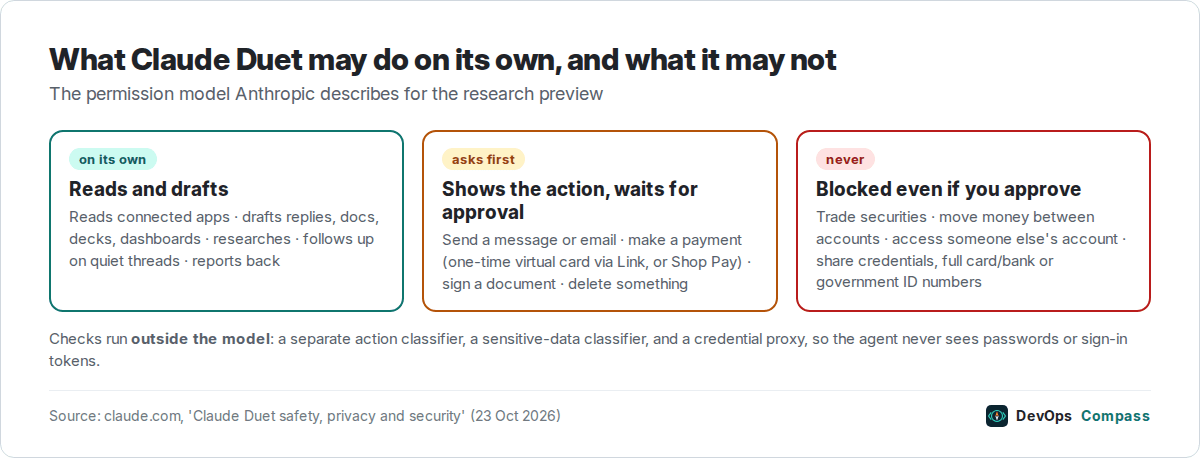
- On its own: read your connected apps, research, draft replies, documents, decks and dashboards, and follow up.
- Only after you approve: sending messages or email, making payments, signing documents and deleting things. Before approval it shows you the exact action, the destination and the content, including all recipients.
- Never, even with approval: trading securities, moving money between accounts and accessing someone else's account. Some steps cannot be set to "don't ask again".
For purchases, Duet pays with a one-time virtual card from Stripe's Link wallet, limited to one merchant and one amount, so your real card number is not shared. It can also check out with Shop Pay. Anthropic says saved 1Password logins are "coming soon".
Safety and privacy details
From Anthropic's 23 October safety article:
- Checks run outside the model. A separate automated check decides whether each action matches your intent, so instructions hidden in a web page should not be able to switch approvals off. This is Anthropic's main answer to prompt injection.
- It never sees your passwords or tokens. Passwords are typed into an in-app form, encrypted and passed to the browser without the model reading them. Sign-in tokens are replaced with placeholders inside the agent's machine, and a proxy outside it inserts the real value only when a request is made.
- Sensitive data classifier. Credentials, full card and bank numbers and government ID numbers are never shared. Health and financial details are shared only with your consent (your own request usually counts).
- Memory persists. Duet keeps its conversation history and its own memory until you delete the history or reset the memory. Disconnecting an app stops new access but does not erase what Duet already learned from it.
- Websites can identify it. Duet's browser uses a distinct User-Agent and published IP addresses. Anthropic says some large sites chose to block it.
- Anthropic describes evaluations, red-teaming, an external penetration test and a public bug bounty.
The safety article does not say whether Duet data is used for model training, and the help center documents no step-by-step procedure for deleting Duet's memory. Your general Claude privacy settings are the place to check.
Known limitations (Anthropic's own list)
Anthropic is unusually direct about what does not work yet:
- It can misjudge what is urgent or misread a thread, and it can miss something that arrives between check-ins.
- You cannot watch or take over its browser yet.
- It cannot make phone calls or send texts. It can send email from connected accounts, with your approval.
- It cannot see all of your projects or local files, and it cannot change your other Claude work.
- Personal errands such as booking tickets are weaker than business admin tasks.
- Microsoft 365 is listed as an example on the product page but is "not available yet" according to the help center. Check the connector list in your settings.
Claude Duet vs OpenAI Dots vs Meta Muse
All three are "always-on" agents that run on their own cloud computers. The table below uses Anthropic's own pages for Duet and launch coverage for the other two (we found no official pricing pages we could verify for Dots tiers or Muse limits).
| Claude Duet | OpenAI Dots | Meta Muse | |
|---|---|---|---|
| Announced | 21 Oct 2026 (research preview) | 29 Sep 2026 (DevDay) | 8 Sep 2026 |
| Model | Claude Opus 5.5 | GPT-6 Astra (per SiliconANGLE) | Meta's latest models, not named (per Axios) |
| Who can use it | US Pro and Max, waitlist | ChatGPT Pro and Business Premium; not for Pro users in the EEA, Switzerland, UK; Enterprise beta if an admin enables it | US first (per TNW) |
| Where you talk to it | Duet app (iOS, Android), claude.ai | ChatGPT (web, desktop, mobile), Slack, Teams | iOS, Android, web; AI glasses later (per TNW) |
| Price | Included; uses plan limits | First dot included; usage not counted for the first month (per SiliconANGLE) | Free tier; paid tiers $20 and $100 per month (per Axios) |
| Approvals | Before send, pay, sign, delete; some actions never allowed | "Auto-review" before actions that touch accounts or share data; idle research is read-only | "Sentinel" system: low-risk tasks run automatically, pauses before consequential actions; read and write access separated (per TNW) |
The practical differences today:
- Availability is the biggest one. Duet is the most restricted (US, waitlist). Dots needs ChatGPT's top consumer plan or Business Premium. Muse has a free tier but is US-only.
- Where it lives. Dots meets you inside Slack and Teams, which suits teams. Duet keeps everything in one dedicated thread and app, which suits a single professional or small-business owner.
- Guardrails. All three pause before consequential actions. Duet's published "never, even with approval" list (trading securities, moving money between accounts) is the most explicit hard limit we found. We know of no independent public audit of any of the three yet.
What about Grok Bot? People search for "Claude Duet vs Grok Bot", but as of 25 October 2026 we could not find official xAI documentation on Grok Bot's availability or pricing, so we do not compare it here.
What users report
Claude Duet is days old and invite-only, so there are almost no hands-on reports yet. What exists are early reactions and comparisons from people who use similar agents. These are other people's opinions, linked so you can read them in context; we have not verified them.
- Big interest, mixed trust. The launch post on Hacker News reached 565 points and more than 500 comments on 21 October (Hacker News thread). The most-discussed comment came from a user who says they already rely on OpenAI's Dots for large personal projects and that a "true frontier model" behind the assistant is what lets them trust its output (intenex, comment).
- Sign-up friction. One commenter criticised that the waitlist is a separate form instead of something you can request from an existing Claude chat, where Anthropic already knows who you are (TheAceOfHearts, comment).
- Password manager worries. The planned 1Password integration raised concern: "is giving an LLM access to your password manager the mother of all bad ideas?" (roarcher, comment). Anthropic's safety article says the model never sees passwords or sign-in tokens (see Official facts).
- Experience with a rival agent. A Dots user says it was weak at coding tasks but useful as a monitor of their communication channels, surfacing buried emails that mattered, and plans to try Duet (joshstrange, comment).
- Lock-in and privacy. Several commenters prefer agents that are not tied to one model vendor, or say they will not hand personal data and decisions to any of the big labs (ZeroCool2u, comment; juanre, comment).
- Websites blocking agents. One user notes that many sites block Claude from reading their pages, which makes online tasks less reliable (BoppreH, comment). Anthropic itself says some large sites chose to block Duet's browser.
- A builder's view. A developer who has run a hand-built equivalent (Claude Code bots with approval cards in Slack) for a year, and who has not used Duet, praises the ask-before-acting design and the quiet-by-default check-ins, but worries that a separate app is one more place to forget to check, and asks whether corrections you give Duet will persist (Bots in Production).
Press coverage frames Duet as Anthropic's answer to Meta's Muse and OpenAI's Dots. Reuters describes it as a standalone agent app for professionals and small-business owners and notes that Meta's Muse drew millions of downloads (Reuters via KFGO). Paul Thurrott points out that Duet targets work rather than everyday personal tasks (Thurrott).
Our take
This is our opinion, based on the official facts and the reactions above:
- Join the waitlist if your day is email, calendar and business admin, you are a US Pro or Max subscriber, and your tools are in the supported list (Gmail, Google Calendar, Google Drive, Slack, QuickBooks, HubSpot, Docusign, Calendly). That is the use case Anthropic designed for and the press highlights.
- Watch your limits. Background checks use the same five-hour and weekly budget as your chats. If you already hit limits, Duet will make that worse; the one-time limit reset until 30 November helps you test it.
- Start small. Connect one or two low-risk apps first, read every approval screen, and remember that disconnecting an app does not delete what Duet already learned from it.
- The safety design is the most detailed published so far, especially the "never, even with approval" list and the credential proxy, but it is a research preview and nobody has published an independent audit. Treat it like a new assistant on probation.
- For developers and DevOps teams, Duet is not a coding agent and has no API. For AI that touches infrastructure, a scoped tool with explicit read-only and write permissions is the safer pattern, as in our Terraform MCP server setup and safety guide.
What we did not test
- No hands-on use. Duet is US-only and invite-only, and we have no invitation. Official facts come from Anthropic's pages, user reactions from the linked posts.
- No benchmarks. Anthropic published no Duet-specific benchmark. Model benchmarks for Opus 5.5 do not measure how well an agent handles your inbox, so we do not quote them here.
- Launch dates for other regions and for Team/Enterprise: not announced.
- Competitor details (Dots, Muse) come from press coverage at launch, not from the vendors' own pages.
FAQ
Is Claude Duet out?
Yes, as a research preview since 21 October 2026, but only for US Claude Pro and Max subscribers who get an invitation from the waitlist. Joining the waitlist does not guarantee a date.
Is Claude Duet free?
There is no extra charge for Pro and Max subscribers during the research preview. You still need a paid plan (Pro is $20 per month billed monthly, Max starts at $100 per month), and Duet's background work uses your plan's five-hour and weekly limits.
How do I sign up for Claude Duet?
Go to the Claude Duet product page, select "Join the waitlist", use the same email as your Claude account, and pick your plan and phone type. When the invitation arrives, open it on your phone and install the app with the matching Apple or Google account.
Is Claude Duet available on Android?
Yes. Anthropic lists standalone apps for iOS and Android, plus claude.ai in a browser on a computer. The invitation must be opened on the phone, with the Google account that matches your waitlist email.
Is Claude Duet available in the UK, Europe or outside the US?
Not yet. The research preview is limited to Claude accounts in the United States, and Anthropic has not announced dates for the UK, the EU or any other region.
Can I use Claude Duet with a Team or Enterprise plan?
Not yet. Anthropic says Team and Enterprise plans are not supported during the research preview; only individual Pro and Max subscribers in the US can join the waitlist.
Which model does Claude Duet use?
Claude Opus 5.5, according to Anthropic's announcement and help center. You cannot switch Duet to another model, and its work counts against your plan's usage limits like normal chat.
Is Claude Duet safe?
Anthropic built in approvals before sending, paying, signing or deleting, a hard ban on actions like trading securities and moving money between accounts, a credential proxy so the model never sees passwords or tokens, and checks that run outside the model to resist prompt injection. It is still a research preview: Anthropic says its classifiers will sometimes miss things, so review every approval request.
What is the difference between Claude Duet and OpenAI Dots?
Both are always-on agents with their own cloud computers. Duet runs on Claude Opus 5.5, is US-only behind a waitlist for Pro and Max, and lives in its own app. Dots runs on GPT-6 Astra (per launch coverage), is available to ChatGPT Pro and Business Premium users (Pro excluded in the EEA, Switzerland and the UK), and can be reached from ChatGPT, Slack and Teams.
Are there any Claude Duet reviews yet?
Not hands-on ones, as of 25 October 2026. Duet is a US-only, invite-only research preview, and the early posts we found are reactions and comparisons from people who use similar agents (linked in "What users report"), not tests of Duet itself.
Sources
- Anthropic: Introducing Claude Duet (21 Oct 2026).
- Anthropic: Claude Duet product page (features, FAQ, waitlist).
- Anthropic help center: Get started with Claude Duet (requirements, steps, usage limits, limit reset until 30 Nov 2026, limitations).
- Anthropic: Claude Duet safety, privacy and security (23 Oct 2026).
- Anthropic: Claude pricing (Pro and Max prices, checked 25 Oct 2026).
- SiliconANGLE: OpenAI launches Dots, always-on AI agents in ChatGPT (29 Sep 2026).
- Axios via Benton Institute: Meta debuts Muse, its long-planned personal AI agent (8 Sep 2026; pricing tiers, models).
- The Next Web: Meta launches Muse, a personal AI agent (availability, platforms, Sentinel approvals).
- Reuters (via KFGO): Anthropic unveils Claude Duet AI agent app (21 Oct 2026).
- Thurrott: Anthropic announces Claude Duet, a personal AI agent (21 Oct 2026).
- User reports: Hacker News launch thread and the comments linked above; Bots in Production (22 Oct 2026).
Update log
- 25 October 2026: first version (Anthropic announcement of 21 October, safety article of 23 October, help center, early user reactions).
Last verified: October 2026 (25 October 2026). Research preview: features, limits and availability may change quickly. We will update this page and the log above when Anthropic expands access.
Header image: Image: DevOpsCompass.
great
ReplyDeleteClaude Duet highlights the evolution of AI assistants from reactive chatbots to proactive agents that can work across connected applications, manage tasks, and prepare content with less manual intervention. Its ability to handle background workflows, maintain context, and request approval before sensitive actions makes it an interesting development in the agentic AI landscape. Understanding its capabilities, limitations, safety controls, and integration with external tools is important when evaluating the future of AI-powered productivity.
ReplyDeleteFor developers interested in exploring Claude's capabilities beyond everyday conversations and learning how to work with AI-assisted development workflows, Claude Certified Developer Training is a relevant learning resource.
As AI assistants increasingly support automation, research, and multi-step tasks, understanding different AI platforms and their practical applications becomes valuable. AI Tools Training provides an opportunity to explore AI technologies and learn how they can be applied in professional workflows.
ReplyDelete