
Gemini 4 Hydrogen Price: Cheaper Per Task Than 3.8 Flash?
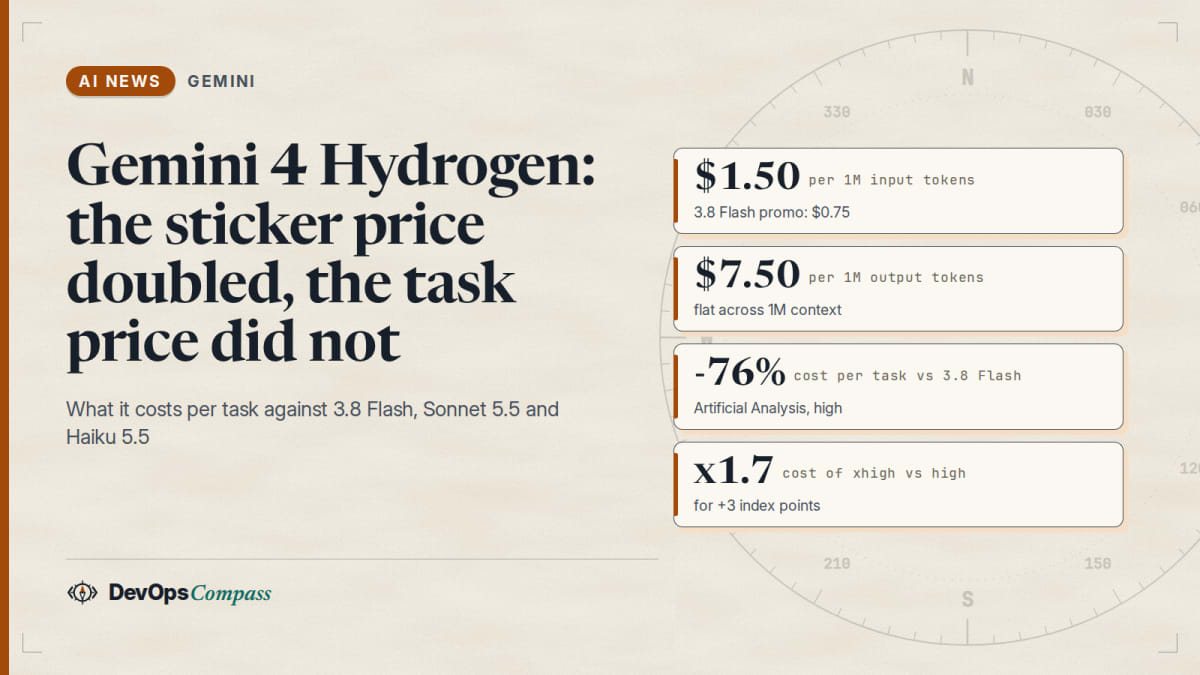
In short: on 12 November 2026 Google released Gemini 4 Hydrogen (gemini-4-hydrogen), a fast model with a 1 million token context window. It costs $1.50 per million input tokens and $7.50 per million output tokens, flat across the whole window, and it is free to try in Google AI Studio. That is double today's price of Gemini 3.8 Flash ($0.75 / $3.75 until 31 December), and the same as 3.8 Flash from 1 January. Our thesis: the sticker price is the wrong number to judge it by. In Artificial Analysis's own tests it costs $1.87 per task at the default high setting against $7.77 for 3.8 Flash (76% less), with a much higher score. The trap is xhigh, which costs about 1.7 times more than high for 3 more index points. How this article was made: we read Google's announcement, API docs and pricing page, Artificial Analysis's model pages, Anthropic's price list and the Hacker News threads, then did the sums. We did not call the API.
The questions this answers: is Hydrogen really twice the price of 3.8 Flash, what does a task cost against Sonnet 5.5 and Haiku 5.5, which thinking level to pay for, and what breaks when you migrate? Official facts, user reports and our opinion are kept apart.
Official facts
Checked on 13 November 2026 on Google's blog, the Gemini API docs and Antigravity's blog.
| Item | Fact | Source |
|---|---|---|
| What it is | The fast, efficient member of the Gemini 4 family, next to Carbon (strongest) and Argon (efficient frontier), aimed at everyday coding and agent workflows | Google blog |
| Model ID | gemini-4-hydrogen, stable, in the Gemini API (Interactions API and GenerateContent) and Google AI Studio |
Model page |
| Inputs and outputs | Text, image, video, audio and PDF in; text out. No image or audio generation, no Live API | Model page |
| Context and output | 1,048,576 tokens shared by input, thinking and output; 65,536 output tokens per synchronous call, up to 1,048,576 with long decode | Model page |
| Thinking levels | low, medium, high (default) and a new xhigh |
What's new |
| Price, paid standard | $1.50 per 1M input, $7.50 per 1M output (thinking tokens count as output), cached input $0.075 (implicit caching only) | Pricing |
| Price, Batch and Flex | $0.75 input, $3.75 output, $0.0375 cached | Pricing |
| Price, Priority | $2.70 input, $13.50 output | Pricing |
| Free tier | Free of charge and rate-limited; on the free tier Google may use your data to improve its products, on the paid tier it does not | Pricing |
| Where | AI Studio, Gemini API, Android Studio, Gemini for business, the Gemini app and Google Search; Google Antigravity for paid AI Pro and Ultra plans | Google blog |
Google's own performance claims, all from its announcement and not checked by us: 51 on the Artificial Analysis Intelligence Index at high (Argon scores 50) and 54 at xhigh; 57% on Terminal-Bench 4.1 against 18.2% for 3.8 Flash; tasks finished 2.5 times faster than 3.8 Flash; fabricated claims cut by more than 5 times; and, from early partners, 2 to 2.8 times faster runs with 12% to 23% fewer tokens than 3.8 Flash.
Is Hydrogen really twice the price of 3.8 Flash?
Per token, yes, today. Here are the dated prices on Google's pricing page, per million tokens (input / output):
| Model | Now | Change |
|---|---|---|
| Gemini 4 Hydrogen | $1.50 / $7.50 | none listed |
| Gemini 3.8 Flash | $0.75 / $3.75 | $1.50 / $7.50 from 1 January 2027 |
| Gemini 4 Argon and Carbon | $2.00 / $10.00 | $4.00 / $20.00 from 1 December 2026 |
| Gemini 3.5 Flash-Lite | $0.30 / $2.50 | none listed |
So Hydrogen is not "priced like a Pro model": it is priced at the normal, post-promotion price of 3.8 Flash, and the 3.8 Flash discount ends on 31 December. The frontier models Argon and Carbon double on 1 December, so the whole Gemini 4 ladder is cheaper right now than it will be in three weeks.
A Hacker News commenter wrote that "from Jan 1 all Google models get 2x price bump". That is not what the page shows. We found dated increases on specific models (Carbon, Argon, 3.8 Flash, 3.6 Flash, 2.5 Pro and Flash, two Robotics previews), but none on Hydrogen or 3.5 Flash-Lite.
What breaks when you migrate from 3.8 Flash?
Google's migration checklist is short but has sharp edges. From the official docs (we did not run any of it):
- Change the model ID from
gemini-3.8-flashtogemini-4-hydrogen. thinking_level: minimalis rejected with an error. The default ishigh, notmedium, so an unchanged app thinks more and pays more per call.- Explicit context caching is gone.
cachedContentsandcaches.createare not supported; removecached_contentfrom requests. Implicit caching runs automatically on prompts of at least 4,096 tokens and discounts cached input by 95%. temperature,top_pandtop_kare ignored. Remove them.- Declare tools natively. If a prompt asks the model to emit raw JSON "tool calls" with no declared tools, it can return
MALFORMED_FUNCTION_CALL. - Raise low output caps. Input, thinking and output share one 1,048,576-token window, and thinking tokens count against
max_output_tokens. A hard cap of 8,192 may cut answers; Google suggests 65,536. - Keep thought signatures unchanged in multi-turn histories, or use
previous_interaction_idin the Interactions API. - Outputs beyond 64K tokens need
background: true.
The quickstart in the docs uses the Interactions API:
from google import genai
client = genai.Client()
interaction = client.interactions.create(
    model="gemini-4-hydrogen",
    input="Summarize this stack trace and propose a fix.",
    generation_config={"thinking_level": "medium"},
)
print(interaction.output_text)
Which Gemini 4 model should you use?
Google's guidance, not our test: Hydrogen for everyday coding, interactive apps, tool-using agents, multimodal documents and parallel sub-agents; Carbon for hard architecture, debugging, science and security audits; Argon for most advanced long tasks with fewer tokens than Carbon. Google calls Hydrogen the recommended upgrade from 3.8 Flash and earlier. Keep 3.5 Flash-Lite ($0.30 / $2.50) for high-volume classification and routing.
One practical detail: Hydrogen defaults to high and allows xhigh; Carbon and Argon default to medium and stop at high. The model IDs can be mixed in one multi-turn session with previous_interaction_id, which is how you can plan with Carbon and execute with Hydrogen.
What does a task cost: Hydrogen vs 3.8 Flash, Sonnet 5.5 and Haiku 5.5?
Start with the arithmetic that makes Hydrogen look expensive. Take 1,000 agent tasks of 100,000 input tokens and 10,000 output tokens each, with no caching, at list prices:
| Model | Price per 1M in / out | Cost per task | Per 1,000 tasks |
|---|---|---|---|
| Claude Haiku 5.5 | $0.10 / $0.50 | $0.015 | $15 |
| Gemini 3.8 Flash until 31 Dec | $0.75 / $3.75 | $0.1125 | $112.50 |
| Gemini 4 Hydrogen | $1.50 / $7.50 | $0.225 | $225 |
| Gemini 3.8 Flash from 1 Jan | $1.50 / $7.50 | $0.225 | $225 |
| Claude Sonnet 5.5 | $2 / $10 | $0.30 | $300 |
| Gemini 4 Argon or Carbon from 1 Dec | $4 / $20 | $0.60 | $600 |
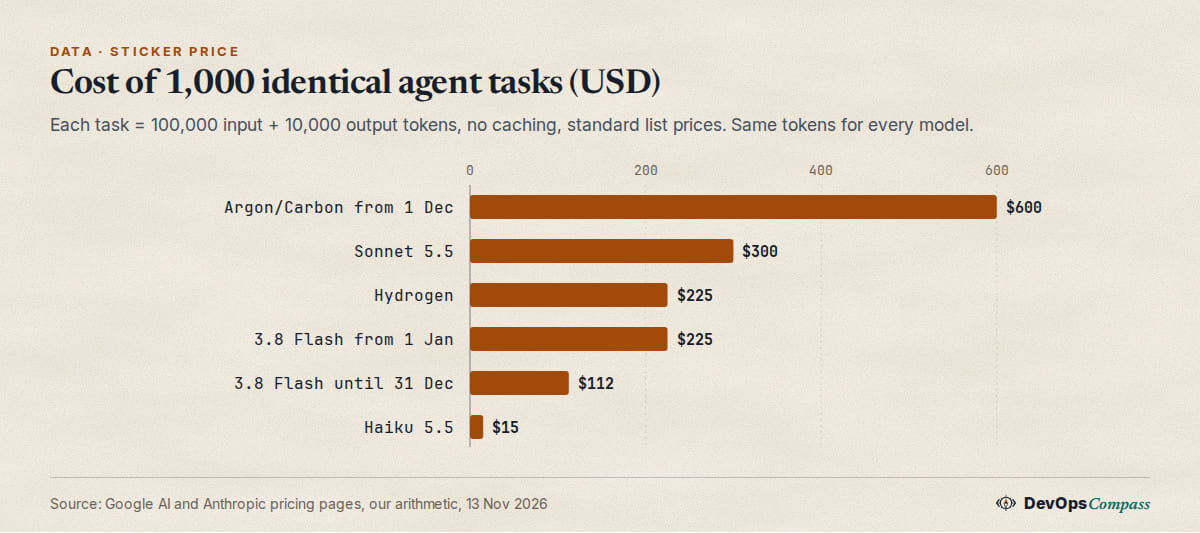
With identical token counts, Hydrogen costs exactly twice 3.8 Flash today. For it to match 3.8 Flash's current price it would have to use half the tokens. Google's partner figure of 12% to 23% fewer tokens is far from that. If you stopped here, you would stay on 3.8 Flash until the end of the year.
But identical token counts is not how agents behave. A slow model that needs more steps reads the context again on every step, so input tokens balloon. Artificial Analysis, an independent evaluator, runs the same index on every model and reports what it cost to complete one task at list prices:
| Model (setting) | Index score | Cost per task | Minutes per task | Output tokens, whole run |
|---|---|---|---|---|
| Gemini 4 Hydrogen (low) | 27 | $0.29 | 1.3 | not collected |
| Claude Haiku 5.5 (Max) | 36 | $0.41 | 14.7 | 298M |
| Gemini 4 Hydrogen (medium) | 41 | $0.80 | 3.7 | 54.4M |
| Gemini 4 Hydrogen (high) | 51 | $1.87 | 7.9 | 110M |
| Gemini 4 Hydrogen (xhigh) | 54 | $3.16 | 13.7 | 304M |
| Gemini 4 Argon (high) | 50 | $4.97 | 30.0 | 113M |
| Gemini 4 Carbon | 60 | $5.48 | 28.4 | not collected |
| Gemini 3.8 Flash (high) | 31 | $7.77 | 14.7 | 126M |
| Claude Sonnet 5.5 (Max, Default Fallback) | 55 | $10.02 | 34.1 | 335M |
Sources: Artificial Analysis model pages for Hydrogen, Hydrogen high, Hydrogen medium, Hydrogen low, 3.8 Flash, Argon, Carbon, Haiku 5.5 and Sonnet 5.5, 13 November 2026. The Artificial Analysis xhigh row is the page's default for "Gemini 4 Hydrogen"; the other Hydrogen rows are its separate pages.
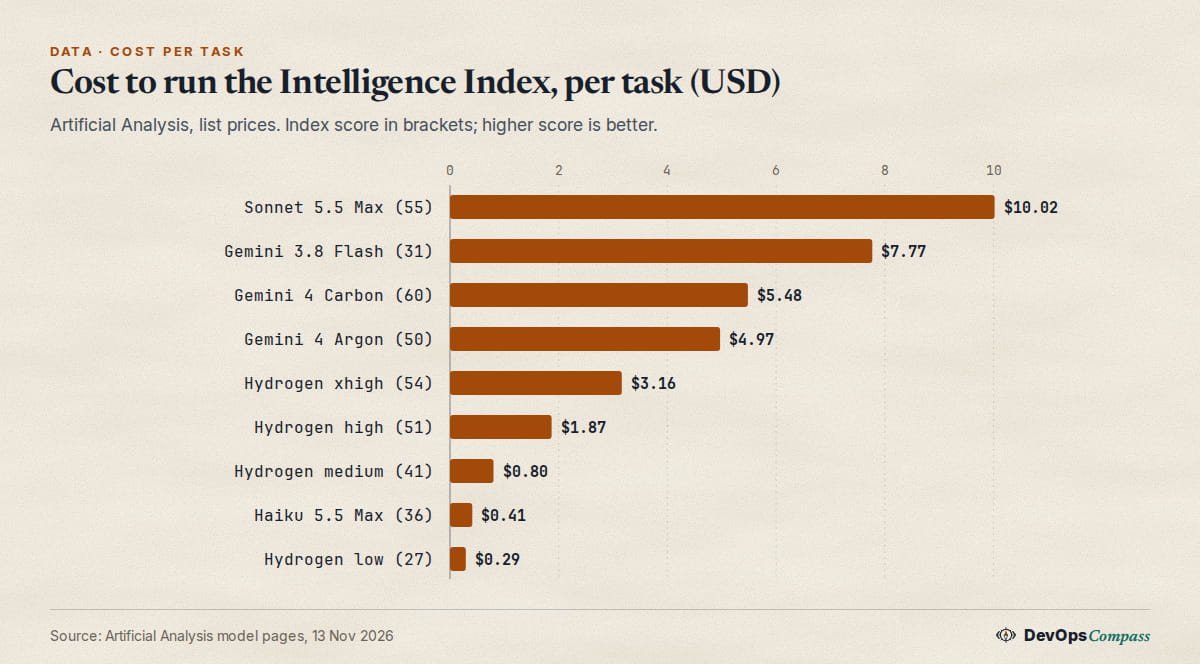
Read the table with these three points in mind:
- Hydrogen at
highcosts 76% less per task than 3.8 Flash and scores 51 against 31. Its token price is double, but it needed about half the input tokens in that run (5.34 billion against 10.2 billion) and finished in just over half the time. Evenmedium(score 41) costs about a tenth of 3.8 Flash per task. - The 3.8 Flash row will get worse. At the 1 January price, with the same token use, it would cost about $15.50 per task (our arithmetic), so Hydrogen at
highwould be about 88% cheaper. - Against the Claude models: Sonnet 5.5 scored 55 for $10.02 per task, Hydrogen
xhighscored 54 for $3.16, about a third of the cost. Haiku 5.5 is cheaper than Hydrogenmedium($0.41 against $0.80) but scores 5 points lower in this test, and Anthropic's "Max" effort is not a setting most apps run at.
These are one evaluator's numbers on one benchmark suite, run by a third party at list prices and with Artificial Analysis's own cache assumptions. They do not know your prompts, tool schemas or caching, so treat them as a reason to run your own test, not as a bill. Our other 2026 price posts use the same method: Haiku 5.5 API prices and what Fable 5.2 costs.
Is xhigh worth paying for?
Probably not as a default. Against high, xhigh gained 3 index points (54 against 51) but cost $3.16 against $1.87 per task (1.7 times), took 13.7 minutes against 7.9, and produced 304 million output tokens against 110 million (2.8 times). Google's own docs say the same in softer words: xhigh is for "hard, multi-step problems where high falls short" and "can cause overthinking on simpler prompts". Artificial Analysis rates xhigh verbosity 76th of 77 models.
Our approach would be: start at medium for interactive coding, run your own tests, move up to high only when failures justify it, and keep xhigh for a retry path after a failure. That matches Google's advice to "pick the lowest thinking_level that meets your quality bar".
Does Orchestrator save money?
Orchestrator is a new model choice in Google Antigravity that switches between Carbon and Hydrogen inside a single session: Carbon plans in a read-only phase, Hydrogen writes edits and runs tests, and it hands back to Carbon when it hits trouble. On Terminal-Bench 4.1 Google says it reached near-Carbon success while using 24% less quota and finishing 19% faster. That is a quota figure inside Antigravity, not an API price, and "near" is not "equal". Google's announcement quotes the same result under the Terminal-Bench 4.0 name, so check the benchmark version before you quote it.
It also depends on where you run it. Hydrogen in Antigravity needs a paid Google AI Pro or Ultra plan according to the announcement; the API route is open to everyone, including the free tier. Hacker News commenters were wary of leaving the model choice to the model (more under What users report), and one noted that Anthropic's advisor mode works the same way. For API users, you can build it yourself with previous_interaction_id: plan on Carbon, execute on Hydrogen, and measure.
What users report
Two Hacker News threads, one with 525 points and one with 406, drew reactions on 12 and 13 November. These are individual claims that we have not verified. Reddit blocks our tools, so nothing here comes from Reddit.
- The price doubled. ComputerGuru says Hydrogen is "priced the same as the non-discounted 3.8 Flash" and asks whether Google is abandoning the cheap tier; pqdbr replies that their 3.8 Flash workload is already costly after a 40% rise from 3.7 Flash (they attribute it to more verbose thinking) and that "this now doubles cost once again", so they would move to OpenAI's Luna. iamdelirium points out that Flash-Lite is still in the Gemini app dropdown.
- The names. wds, vander_elst, jawns and prodigycorp all complain that Hydrogen, Argon and Carbon give no hint of order. One reader says their intuition would make Hydrogen the most powerful of the three.
- Speed and Carbon. artdigital says Argon and Carbon are "so slow" that they used 3.8 Flash instead, and adds that it "sounds like Argon is dead now". Artificial Analysis's 30 and 28 minutes per task for Argon and Carbon fit the complaint.
- Quality experience. krmmalik says that Argon, not Opus or Fable, found a subtle bug in their codebase; this is about Argon rather than Hydrogen. Kotlopou tried a visual puzzle: Hydrogen got the answer right but added a wrong "fun fact".
- Is the middle tier useful? JV00 says they use only the top models or the cheapest and fastest ones; vatsachak calls this class "the workhorses".
- Delegating model choice. fuussssip hesitates to let a model decide how hard a task is, since models "tend to be optimistic about their capabilities", and prefers pinning easy and hard sub-agents. vegardx notes that Anthropic's advisor mode does something similar and wonders how caching works across models.
- Savings elsewhere. jbellis says a setup bridging Opus to DeepSeek Flash saved 60%, so Google's 24% looks modest to them.
- Antigravity access. tobias2014 reports that their account was suspended for using the command-line agent and that an appeal failed; threecheese asks whether a Pro plan can use it. We could not verify either.
Our take
Thesis: Gemini 4 Hydrogen is not a price increase, it is the end of a promotion, and judged per task it is the cheapest way to get Gemini 4 level results. The mistake would be to compare list prices. On the sticker, 3.8 Flash at $0.75 / $3.75 looks twice as cheap, but that price ends on 31 December, and Artificial Analysis's numbers say that at the same quality tier Hydrogen costs a fraction per task. The cheap tier did not vanish; it moved into the low and medium settings, and into Flash-Lite, which keeps its price.
Why we believe this, and where we do not:
- Per task,
highcosts $1.87 against $7.77 and scores 20 points higher in the same test. Even if your workload only matches half of that gap, you still come out ahead after 1 January, when 3.8 Flash costs the same per token. - The risk is on the migration side, not the price list: the default thinking level is higher, explicit caching is gone and sampling parameters are ignored. A team that changes the model ID and nothing else may see its bill move in either direction.
- We do not know your prompts. The Artificial Analysis index is mostly reasoning and agent benchmarks; a simple classification or extraction job may be perfectly happy on Flash-Lite at $0.30 / $2.50.
- Hydrogen is quicker but not the fastest: Artificial Analysis shows 7.9 minutes per task at
highand 3.7 atmedium, with an output speed near 180 tokens per second.
What I would do:
- If you run 3.8 Flash in production today, plan the move before 1 January. Make a test set of 50 to 100 real requests, run
mediumandhighon it, and compare cost per accepted result, not cost per token. Keep 3.8 Flash only if your tests show Hydrogen using more than twice as many tokens. - If you use Argon or Carbon for everything, price the 1 December doubling now. Moving routine steps (edits, test runs, checks) to Hydrogen is the one change Google itself recommends, and the sums above support it.
- If you pay per token for sub-agents, start at
mediumand treatxhighas a retry path, not a default. - If you choose between Claude and Gemini, do not use either vendor's headline price. The Artificial Analysis table shows a 3 times gap per task between Sonnet 5.5 and Hydrogen
xhighat nearly the same score, and a cheaper Haiku 5.5 with a lower score; your data decides. - If you want a hard cap on spend, set
max_output_tokensexplicitly, because thinking tokens are billed as output andxhighproduced 2.8 times the output ofhigh.
Who should care: teams on 3.8 Flash or Gemini 3 Flash models and anyone running coding agents on Argon or Carbon. Who can wait: hobby users on the free tier, and anyone whose workload is plain classification.
What we did not test
- We did not call the Gemini API and ran no model. The code example is based on Google's migration page and has not been run by us.
- We did not measure quality, speed or cost. All benchmark figures are Google's or Artificial Analysis's.
- The 1,000-task table is our arithmetic from list prices with 100,000 input and 10,000 output tokens and no caching; real agents cache and vary. The $15.50 figure for 3.8 Flash after 1 January assumes Artificial Analysis's token use stays the same.
- Artificial Analysis's rows mix settings: Claude rows are Max effort and Sonnet is "Default Fallback", Hydrogen has one page per level, and the Carbon and Argon rows are at current promotional prices. We did not check whether the evaluator applies the same caching assumptions to every vendor.
- We did not check Hydrogen on Vertex AI, rate limits for each tier, Antigravity quotas or the Google Search upgrade.
- Every Hacker News statement is the commenter's claim.
FAQ
Is Gemini 4 Hydrogen free?
Partly. Google AI Studio and the Gemini API have a rate-limited free tier at no charge, and on that tier Google may use your data to improve its products. The paid tier costs $1.50 per million input tokens and $7.50 per million output tokens, and does not use your data for that purpose. Free Gemini app users get it through automatic model selection.
How much does Gemini 4 Hydrogen cost?
$1.50 per million input tokens and $7.50 per million output tokens on the paid standard tier, flat across the 1 million token window. Cached input is $0.075. Batch and Flex cost half of standard, and Priority costs $2.70 and $13.50.
Is Gemini 4 Hydrogen better than Argon?
On Artificial Analysis's index it scores 51 at high against Argon's 50, and it finished tasks in 7.9 minutes against 30. Google positions Argon and Carbon for deeper, long-horizon work. Carbon scores 60 in the same index, so the frontier model still leads on the hardest tasks.
Why are the Gemini 4 models called Hydrogen, Argon and Carbon?
Google has not explained the order. Hacker News readers complained that the names suggest an order that does not match capability. In practice: Carbon is the strongest, Argon the efficient frontier model and Hydrogen the fast everyday one.
Is Google dropping its cheap Flash-Lite tier?
Not according to the documents we read. Google's migration page tells users to keep Gemini 3.5 Flash-Lite ($0.30 / $2.50) for high-volume classification and routing, and its pricing page lists no dated increase for it.
Can I use Hydrogen in Google Antigravity on a Pro plan?
Google says paid Google AI Pro and Ultra subscribers can use it in Antigravity. We did not check usage limits per plan, and one Hacker News reader reported an account suspension that we could not verify.
Does Hydrogen support context caching?
Only implicit caching. Prompts of at least 4,096 tokens are cached automatically with a 95% discount on cached input; explicit caching with cachedContents is not supported.
Related guides
- Gemini Decisions API: price vs OpenAI and Haiku 5.5 for Google's other launch this week.
- Claude Fable 5.2 price: is it worth double Opus? for the premium end of the market.
- GPT-6.1 Terra: API price, context, benchmarks and limits for OpenAI's current price list.
- Claude Haiku 5.5 API: price, effort levels, migration for the cheap Claude baseline.
Sources
- Google blog: Introducing Gemini 4 Hydrogen and Gemini 4 Hydrogen: everyday coding and agentic workflows for developers (12 Nov 2026).
- Antigravity blog: Gemini 4 Hydrogen and Orchestrator now in Google Antigravity (12 Nov 2026).
- Gemini API docs: What's new in Gemini 4 Hydrogen, model page, pricing, changelog.
- Artificial Analysis: Gemini 4 Hydrogen, Gemini 3.8 Flash, Claude Sonnet 5.5.
- Claude docs: pricing.
- Hacker News: thread 50471431 and thread 50472260.
- Google autocomplete suggestions for "gemini 4 hydrogen", "gemini 4 hydrogen vs" and "gemini 3.8 flash" (13 Nov 2026).
Update log
- 13 November 2026: first version, from Google's announcement and docs, Artificial Analysis's model pages, Anthropic's price list and the Hacker News threads. We will update it if Google changes the price, publishes more on Orchestrator or Vertex AI availability, or Artificial Analysis revises its numbers.
Last verified: November 2026 (13 November 2026). Prices and limits change; we will update this page and the log above.
Header image: Image: DevOpsCompass.
Comments
Post a Comment